


Get A Quote

Content
A 10-can cooler that loses its chill after two hours on a boat deck is not a cooler. It is a wet fabric bag. Yet thousands of such units ship every month, because buyers never verified the three performance numbers that separate a functional insulated container from a decorative pouch: ice retention under controlled conditions, leak rate under seam stress, and material tear strength after UV exposure. This guide defines those requirements so product developers and procurement teams can specify small soft sided coolers with measurable confidence.
A small soft sided cooler is a flexible, insulated container under roughly 20 liters, designed to keep food and beverages cold through passive closed-cell foam insulation without a rigid outer shell.
Small soft sided coolers fill the gap between hard rotomolded boxes and cheap insulated lunch bags. Most units hold 6 to 24 cans, weigh under 1.2 kilograms empty, and collapse partially for storage. Their defining characteristic is structural: because every panel is soft, the seams, zippers, and fabric carry mechanical loads that a rigid cooler absorbs through its shell. This single difference drives every performance requirement covered below.
Ice retention is the primary performance requirement for any soft sided cooler, because it directly measures whether the product performs its core task. A well-built small cooler with 18 to 22 millimeters of closed-cell EPE or EVA foam should keep ice for 18 to 24 hours at 32 degrees Celsius ambient temperature, provided the interior is pre-chilled and the ice-to-content ratio stays above 2:1.
Insulation material matters more than thickness. Closed-cell EPE and EVA foam resist moisture absorption and maintain their R-value after repeated use. Open-cell polyurethane foam can saturate over time, losing insulating performance and adding weight. When evaluating suppliers, request a standardized test protocol that lists ambient temperature, starting internal temperature, ice mass, and drain frequency. An unstandardized test is not a specification, and a documented test result gives you a defensible comparison baseline.
For a deeper look at how insulation is verified during production, see this ice retention performance guide.
Leak resistance is the second mandatory requirement, because a soft-sided structure flexes with every carry, drop, and compression event. Two manufacturing methods dominate: stitched seams with heat-sealed tape, and high-frequency welded seams on TPU films.
High-frequency welding fuses TPU at the molecular level, producing a joint stronger than the surrounding film. Stitched seams leave needle holes that depend on tape or sealant for waterproofing, and tape adhesion degrades with UV exposure, washing, and flexing. For any cooler expected to survive a full season of outdoor use, welded construction is the correct choice.
 New Fuda TPU Welded Soft Cooler with Leak-proof Waterproof ZipperThis TPU travel cooler uses high-frequency welding for leak-proof seams and comes in two sizes holding 18 or 24 cans. Its lightweight EPE insulation and waterproof zipper suit camping trips that demand reliable cold retention.View Product →
For contract manufacturing, process capability matters as much as the cooler itself. New Fuda Luggages & Bags Co., Ltd. builds both stitched and high-frequency welded soft coolers in one facility, which shortens the development cycle when moving from prototype to production.
A practical leak-test standard for small coolers: fill the unit with 20 liters of water, seal it, and lay each side down for 10 minutes. No seepage is acceptable. Premium units must also survive a 1-meter drop test onto a hard surface while filled at 50 percent capacity without seam failure.
Seam construction is closely tied to overall waterproofing. Review the waterproofing, IP rating, and welding guide to understand which certification levels you should demand from a supplier.
Material selection determines real-world service life. Three material families dominate soft-sided cooler construction: TPU film, PVC film, and coated Oxford fabric.
TPU, or thermoplastic polyurethane, is the premium specification. Films from 0.4 to 0.8 millimeter offer high tear strength, UV resistance, and flexibility at temperatures down to minus 20 degrees Celsius. PVC costs less and welds easily, but plasticizer migration causes stiffening and cracking within one to two seasons. Coated Oxford fabric, typically 500D or 600D, adds abrasion resistance on the exterior but depends on an inner film liner for waterproofing.
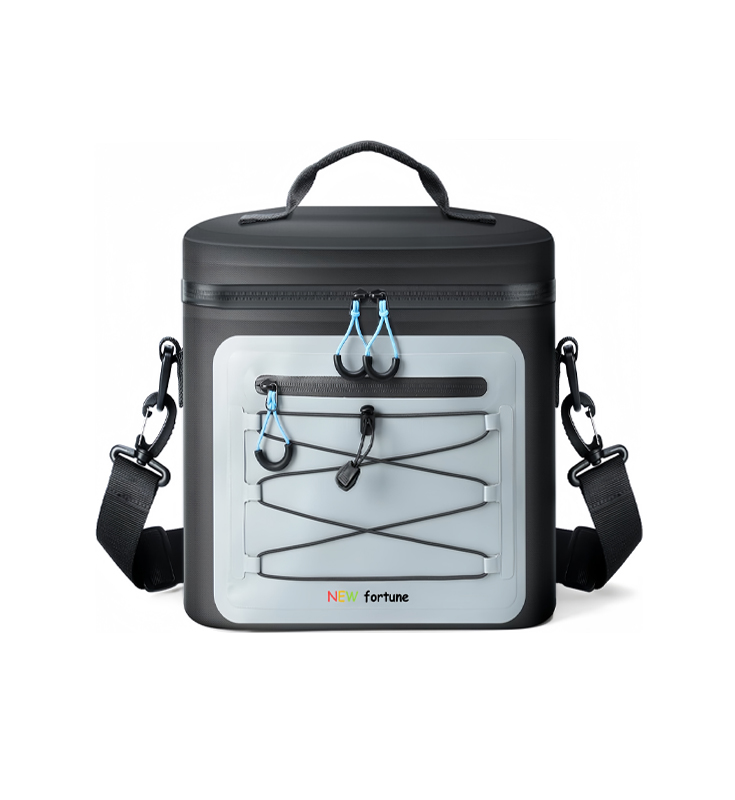 New Fuda Waterproof TPU Soft Cooler with Airtight Zipper for HikingBuilt from durable TPU with an airtight, waterproof zipper, this compact cooler prevents premature zipper failure under pressure. Available in two sizes, it keeps drinks cold during hiking and boating with lightweight EPE insulation.View Product →
The zipper is the most common premature failure point on small soft sided coolers. It must close smoothly and create a watertight seal under internal pressure, which occurs every time a fully packed cooler is squeezed into a trunk or boat storage locker.
Waterproof zippers use polyurethane-laminated tape plus a compression seal pressed into place by the slider. IP ratings indicate the level of protection: IPX5 resists water jets, while IPX7 withstands brief submersion. A cooler destined for kayak or boat use requires IPX7; a picnic cooler can operate at IPX4. Verify which rating your supplier builds into the product, because most zipper suppliers offer multiple grades at different price points.
A small soft sided cooler must be genuinely portable. Empty weight for the 12-can class should stay below 1 kilogram, and shoulder strap attachment points need bartack stitching at every stress point. Handles most often fail when a user loads the cooler to capacity and carries it one-handed, the highest-load scenario in normal use.
Capacity numbers need scrutiny. A manufacturer may claim 24-can capacity, but usable volume drops 20 to 30 percent once ice and irregularly shaped food containers fill the space. Specify usable volume or ask for a can-loading test rather than accepting nominal volume claims.
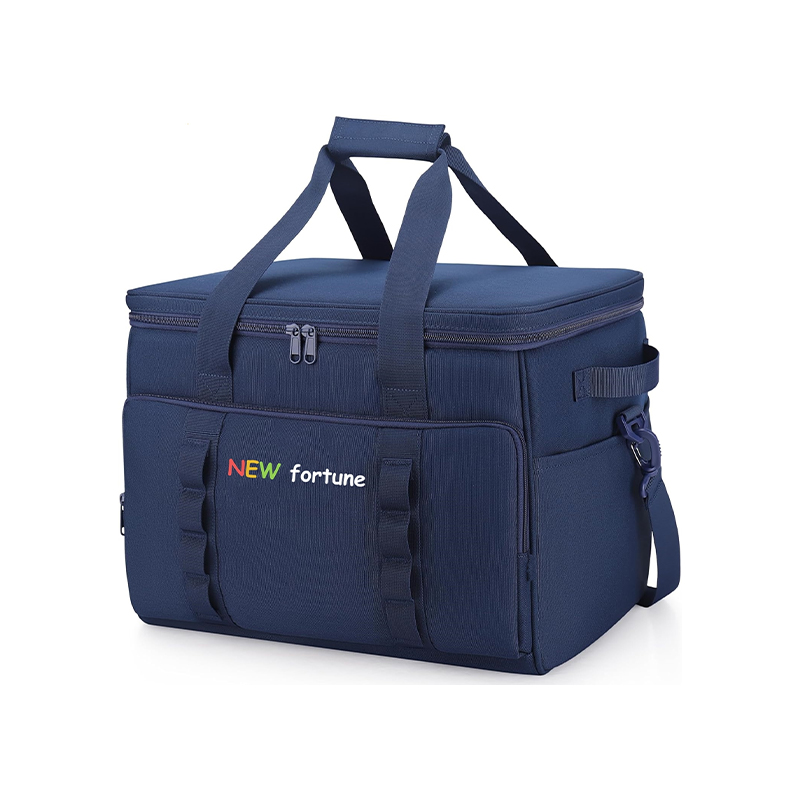 New Fuda Oxford Cloth Insulated Cooler Bag with Waterproof ZipperThis navy Oxford cooler weighs only 550 grams, making it ideal for day hikes and picnics. An EPE thermal layer and PEVA waterproof lining, plus a waterproof zipper, protect food in damp conditions.View Product →
For a 12-can class cooler, expect usable volume around 14 liters. This accommodates 12 cans, a 1-liter water bottle, and 2 kilograms of ice without overstuffing the zipper.
Every interior surface that touches food or beverages must use food-grade material. TPU interior liners should comply with FDA 21 CFR 177.2600 or EU 10/2011 migration limits. PVC interior linings remain common in budget coolers, but phthalate plasticizers present an unacceptable risk for direct food contact in most export markets.
When the performance requirements above are applied side by side, the gap between cooler classes becomes obvious. The following comparison summarizes typical specifications for the 12-can class.
| Feature | Budget Soft Cooler | Quality Soft Sided Cooler | Small Hard Cooler |
| Insulation thickness | 6-10 mm | 18-22 mm | 30-40 mm |
| Ice retention at 32C | 6-10 hours | 18-24 hours | 36-48 hours |
| Empty weight | 0.5-0.7 kg | 0.8-1.2 kg | 3-5 kg |
| Leak resistance | Taped seams | HF-welded TPU | Rigid shell |
| Folded storage | Yes | Yes | No |
| Typical service life | 1-2 seasons | 3-5 seasons | 5+ years |
A quality small soft sided cooler with 18 to 22 millimeters of closed-cell insulation holds ice for 18 to 24 hours at 32 degrees Celsius ambient temperature. Budget models with 6 to 10 millimeters of foam last 6 to 10 hours under the same conditions.
TPU film from 0.4 to 0.8 millimeter thick offers the best combination of tear strength, UV stability, and cold-temperature flexibility. It welds cleanly into leak-proof seams and meets food-safety standards when properly formulated.
Only welded TPU coolers with waterproof zippers are truly leak-proof. Stitched-and-taped constructions resist splashes but degrade at the tape seam after months of use and washing.
Plan on 1.5 cans per person per day, then add roughly 30 percent for ice volume. A 12-can class cooler with about 14 liters of usable volume handles two people on a day trip comfortably.
Your email address will not be published. Required fields are marked *
* Your email is safe with us, we don't spam.

Professional R & D and manufacturing of outdoor sports, cycling, fishing, business, travelling sewing, high-frequency stamping series of luggage enterprises
E-mail: christine@fudabags.com
Phone: +86-13819351116
Add: No.2288 Xinggong Road, Pinghu City, Jiaxing City, Zhejiang Province, China
Copyright © 2025 by New Fuda Luggages & Bags Co., Ltd. Rights Reserved. Privacy Custom Durable Outdoor Travel Bag Manufacturers


 English
 Français
 Español