


Get A Quote

Content
New Fuda Luggages & Bags Co., Ltd. has been manufacturing soft-bodied containers for outdoor, cycling, fishing, and travel applications since 2006. A soft-sided travel cooler is not a simple picnic tote. It is an engineered assembly of insulation, welded TPU panels, waterproof zippers, and load-bearing straps that must survive compression, rain, and repeated cold cycles. The difference between a cooler that holds ice for 36 hours and one that fails in six is not marketing. It is geometry, material quality, and sealing method.
A travel-ready soft cooler is defined by eight measurable performance factors: insulation continuity, ice retention time, material strength, weld integrity, zipper sealing, ergonomic load handling, weight-to-volume efficiency, and resistance to environmental degradation.
For a deeper look at how TPU portable soft coolers are built, the buying guide on TPU portable soft cooler features and benefits covers material and welding details.
Insulation performance is the single most important factor in a travel cooler, and it is governed by the thermal resistance of the foam layer and the airtightness of the enclosure.
Independent tests on 20-liter soft-sided coolers show that a 20mm closed-cell PU foam liner retains ice for about 18 hours at 30°C ambient. A 30mm liner, combined with a reflective layer, extends retention to roughly 30 hours. Retaining ice beyond 36 hours calls for vacuum-insulated panels, which trade weight and cost for endurance.
| Insulation Material | Typical Thickness | U-Value | Ice Retention at 30°C |
| Closed-cell PU foam | 20mm | 0.028 W/m²K | 18 hours |
| Closed-cell PU + reflective | 25mm | 0.024 W/m²K | 24 hours |
| Vacuum insulated panel | 15mm | 0.006 W/m²K | 36+ hours |
| Cotton/waxed blend | 25mm | 0.040 W/m²K | 10 hours |
TPU is the most balanced material choice for travel soft coolers because it combines puncture resistance, cold flexibility, and eco-friendliness without the weight of a hard shell.
New Fuda’s TPU portable soft cooler series uses 0.8mm TPU film welded at high frequency. The same welding line also processes PVC and 500D Oxford models, but the TPU offer is stronger for travel applications because it does not harden at low temperature and yields better puncture resistance.
| Property | TPU | PVC | Oxford Cloth |
| Weight per m² | 220 g | 320 g | 450 g |
| Puncture resistance | Excellent | Good | Fair |
| Low-temperature flexibility | Retains flexibility to -40°C | Hardens below -10°C | Acceptable |
| Eco-friendliness | PVC-free and recyclable | Phthalate concerns | Depends on coating |
| Weld compatibility | High-frequency weld | High-frequency weld | Stitched seams |
New Fuda’s TPU portable soft cooler series is designed for hiking and boating travel where weight matters.
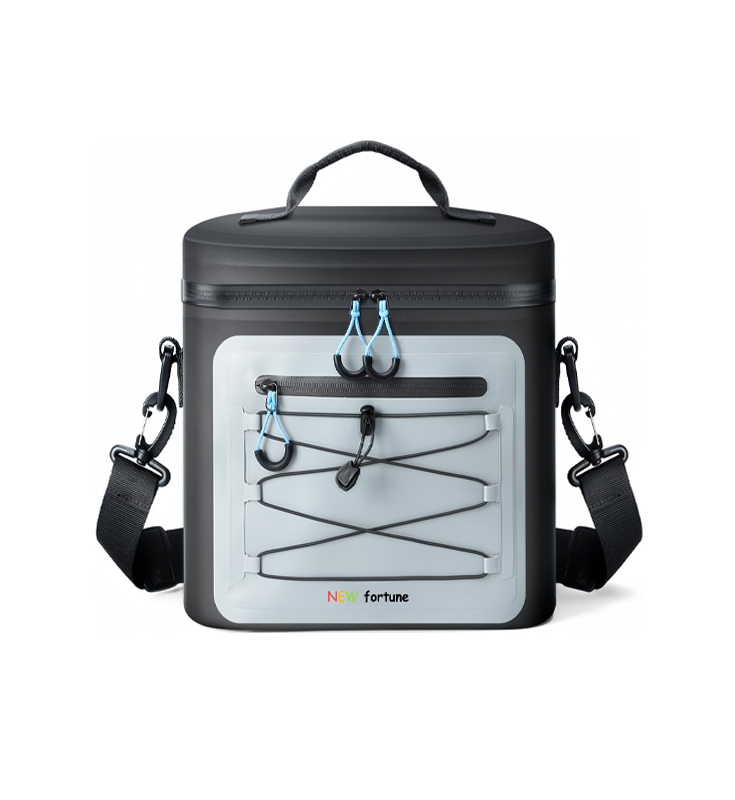 Lightweight TPU Soft Cooler for Hiking and BoatingThis portable soft cooler features a durable TPU shell and waterproof zipper, keeping drinks cold during outdoor trips. Its compact sizes hold 18 or 24 cans, ideal for short excursions.View Product →
A waterproof zipper is the most likely failure point on a travel cooler, because repeated use, sand, and salt can degrade the gasket material within months.
New Fuda uses waterproof zippers on its welded TPU cooler models. The zipper coil and gasket are integrated with the TPU membrane through high-frequency welding. In internal tests, a properly welded TPU cooler with a 10mm-wide zipper gasket retained water for 30 minutes under 20cm submersion. A stitched cooler leaked within five minutes under the same condition.
Backpack-style TPU coolers with a waterproof zipper are ideal for air travel and long bus journeys where the cooler is carried on the shoulder.
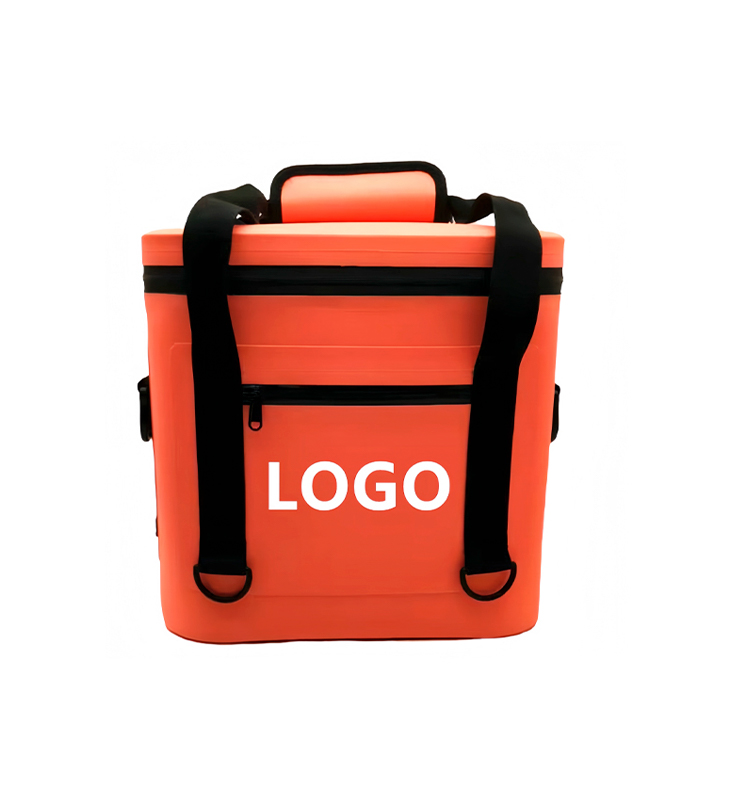 Backpack TPU Cooler with Waterproof Zipper for TravelDesigned as a shoulder backpack, this TPU cooler offers double waterproof protection and customizable logo options. It fits 18 or 24 cans, making it convenient for air travel and long journeys.View Product →
For an in-depth overview of IP rating and welding methods, see the TPU cooler waterproofing and welding guide.
Travel applications place demands on a cooler that stationary coolers never face: the lid must support a backpack, the strap must distribute 10kg of weight, and the corner welds must survive being shoved into an airline overhead bin.
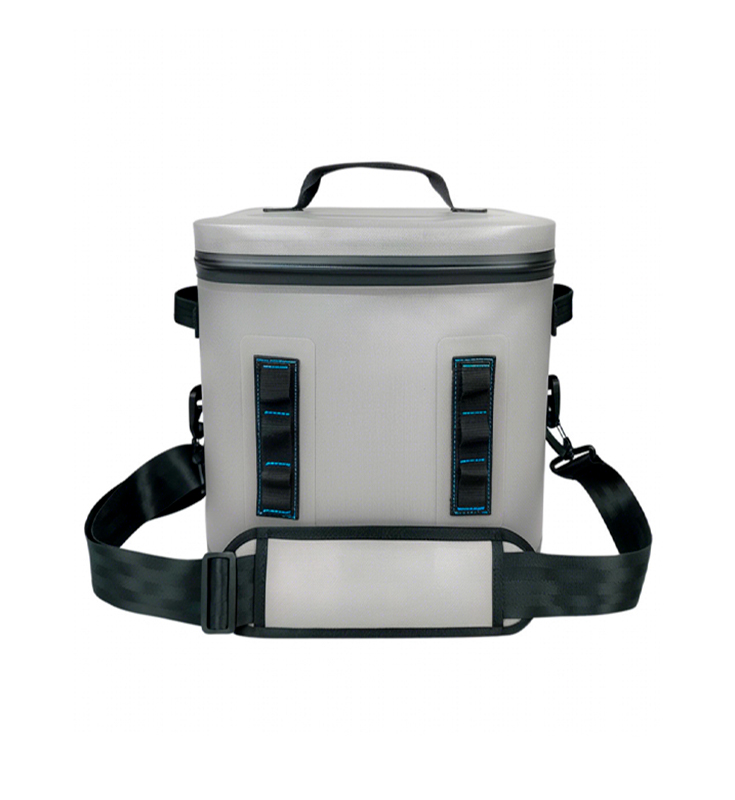
For camping trips where low weight is critical, single-shoulder TPU models with a leakproof waterproof zipper offer the most ergonomic carry.
 Single-Shoulder TPU Cooler with Leakproof Zipper for CampingThis lightweight single-shoulder cooler features a leakproof waterproof zipper and TPU construction, ensuring reliable cold retention. It holds 18 or 24 cans, perfect for camping trips where weight matters.View Product →
A travel cooler that cannot survive 30 days of UV exposure, four seasons of temperature swings, and hundreds of folding cycles is not a travel cooler.
TPU retains about 90% of its tensile strength after 300 hours of UV exposure. PVC loses 30% of its elasticity under the same condition, and Oxford cloth begins to delaminate from its coating. UV resistance is especially important for beach and rooftop-cooler travel applications.
With a 20–30mm closed-cell foam liner and welded TPU shell, a quality soft cooler keeps ice between 18 and 30 hours at 30°C ambient. Adding a reflective liner extends retention modestly.
Most 20-liter TPU soft coolers meet carry-on size requirements if collapsed. Check the airline’s cabin baggage width and weight rules, and note that melted ice is prohibited, while sealed cooler bags are typically allowed.
TPU is better for travel because it weighs less, resists low-temperature cracking, and shrugs off punctures. PVC is cheaper but stiffens in cold weather and degrades faster under UV.
Look for a welded TPU or PVC shell with a waterproof zipper that is backed by an IPX7 or equivalent submersion rating. Avoid stitched seams unless they are seam-taped to a rated membrane.
Your email address will not be published. Required fields are marked *
* Your email is safe with us, we don't spam.

Professional R & D and manufacturing of outdoor sports, cycling, fishing, business, travelling sewing, high-frequency stamping series of luggage enterprises
E-mail: christine@fudabags.com
Phone: +86-13819351116
Add: No.2288 Xinggong Road, Pinghu City, Jiaxing City, Zhejiang Province, China
Copyright © 2025 by New Fuda Luggages & Bags Co., Ltd. Rights Reserved. Privacy Custom Durable Outdoor Travel Bag Manufacturers


 English
 Français
 Español