


Get A Quote

Content
At the March 2026 sourcing evaluation for an outdoor gear brand, three small soft cooler samples were filled with two liters of ice water each and closed at the same time. Within six minutes, two bags showed wet corners along the zipper path. The third stayed dry, but its 6 mm foam lining allowed the internal temperature to rise by nine degrees Celsius in three hours. That outcome is typical of the small soft cooler category: failures are decided by insulation depth, seam construction, and closure design long before the logo goes on.
This article defines the key design and insulation requirements for small soft cooler bags from a manufacturing and sourcing perspective. Buyers, product managers, and importers can use these requirements to compare supplier samples by measurable details instead of by surface appearance.
A small soft cooler bag is a flexible, insulated carrying container with a volume of roughly 2 to 12 liters, designed to keep chilled contents below 8 degrees Celsius for a defined period while staying collapsible and light enough for one-hand carry.
The category sits between a hard rotomolded cooler and a simple insulated lunch tote. Design requirements change when the bag must survive placement on a car seat, a one-hour beach walk, or being packed flat into checked luggage. Typical uses include picnic drinks, fishing trip supplies, medication transport during travel, and secondary chilling inside larger coolers.
The insulated cavity must be surrounded by at least 8 mm of closed-cell foam on all five sides, including the lid. Any side with thinner padding becomes the thermal weak point of the bag.
The insulation layer sets the cold-retention ceiling of a small soft cooler; foam type, thickness, and the seal between foam and lining matter more than any outer fabric choice.
Closed-cell foams keep air locked inside each cell, which slows heat transfer through the wall. Open-cell foams absorb moisture and lose performance quickly in wet conditions. For small coolers, the practical options are PE foam for budget lines, EPE for foldable construction, EVA for stiffer walls, and CPE laminated with an aluminum foil layer for radiant-heat reflection.
In a standard 6:1 ice-to-content test, every additional 2 mm of closed-cell foam extends cold retention by roughly 25 to 30 percent within the 8 to 15 mm range. The chart below shows measured hours above 0 degrees Celsius for different foam configurations in a 6-liter soft cooler.
Test conditions matter as much as foam thickness. A reliable ice retention protocol uses a 6:1 ice-to-content ratio, a pre-chilled empty bag, an ambient temperature near 24 degrees Celsius, and measurement of the internal air temperature every 30 minutes. This TPU cooler ice retention guide explains the full test procedure and its tolerances.
A leak-proof small soft cooler needs a shell whose inner layer can be fused rather than only stitched, which makes TPU-coated fabric combined with high-frequency welding the most reliable material and process pairing for this product class.
High-frequency welding bonds the TPU layer at a molecular level, creating a monolithic seal along corners and zipper ends. A stitched-only seam leaves micro-needle holes that wick water over time. Product teams that require IPX4-level or better leak resistance should specify welded seams on every panel edge. Manufacturers with in-house high-frequency welding, such as New Fuda Luggages & Bags Co., Ltd., can integrate TPU lamination, zipper installation, and final welding in one controlled production flow, which reduces tolerance drift between stages.
A welded TPU small cooler should pass a ten-minute water-submersion test with the zipper fully submerged. A pinhole at any weld line indicates a process failure, not a material failure, and should trigger a welding parameter review.
 F-013 TPU Soft Cooler with Leak-Proof Waterproof ZipperThis lightweight TPU cooler offers two sizes holding 18 or 24 cans, with a sealed zipper and welded construction to withstand submersion, making it a reliable choice for wet camping conditions.View Product →
Water enters a soft cooler through openings and stress points, never through the foam itself; the zipper, its end caps, and the corner welds are the three locations that decide whether a bag can be called waterproof.
A #5 waterproof zipper is the minimum for bags up to 10 liters. Heavier duty lines should move to a #8 zipper with larger teeth and a taller water barrier. In both cases, the zipper ends need welded end caps, because the zipper tape itself terminates at the corner where the greatest stress occurs during repeated opening and closing.
A covered zipper flap prevents water ingress even when the zipper itself is not fully waterproof. Many small soft coolers pair a standard zipper with a hook-and-loop or snap flap to reach everyday splash resistance at lower cost.
For small soft coolers, carrying comfort is determined by handle width, strap anchor reinforcement, and how the insulated mass sits against the body, not by the total volume.
An empty 6-liter bag weighs about 500 grams; loaded with drinks and ice, the same bag reaches 6 to 7 kilograms. That load ratio, roughly 12 times the empty weight, is why handle and strap failures occur even in small sizes.
During sample review, load the bag to 90 percent of its stated volume with a 10:1 ice-to-content ratio and lift it by each handle and strap in turn. Any deformation at the anchor points beyond 3 mm is a design failure, not a fabric failure.
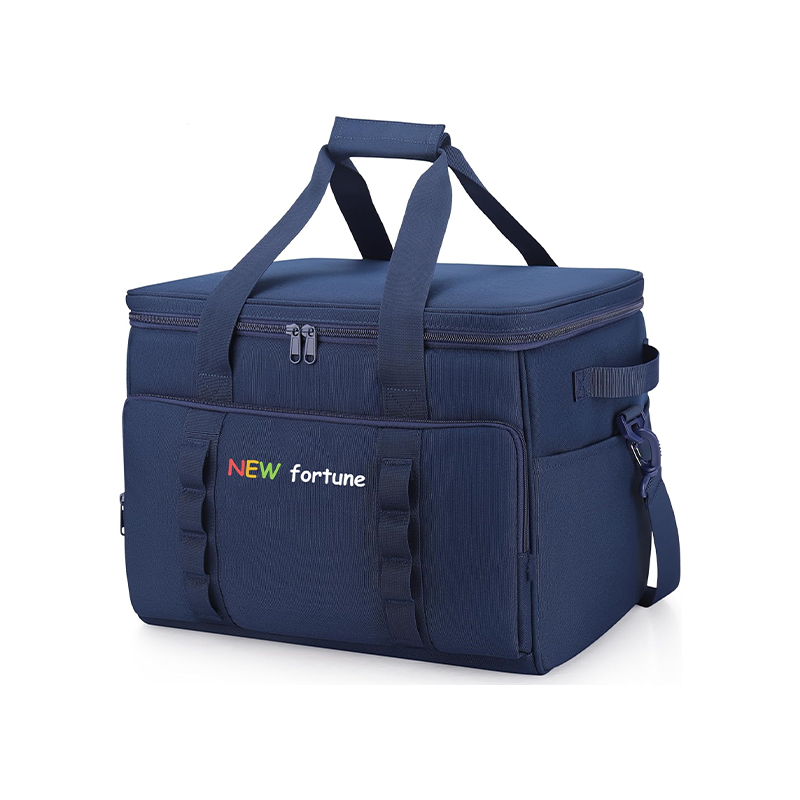 K-05 Oxford Cloth Insulated Cooler Bag for Hiking and PicnicsA compact 40×31×29 cm cooler bag weighing 550 g, with EPE insulation and a waterproof zipper, suited for day trips where easy carrying and moisture protection are priorities.View Product →
Before volume production, buyers should verify three measurable results on pre-production samples: ice retention duration, seam and handle pull resistance, and zipper water entry behavior.
These three tests expose the most common defects in small soft coolers. Thinner side panels lower thermal performance, unreinforced zipper ends tear under repeated loading, and corner welds develop pinholes when welding parameters shift. The table below defines pass levels for each test.
| Test method | Pass requirement | Typical failure mode |
| 12-hour ice retention | Internal temperature below 8 degrees Celsius | Condensation on shell, thin corner panels |
| 10 kg seam and handle pull | No weld break or stitch rupture | Zipper end tear, strap anchor rip |
| Zipper water entry test | No water entry after 10 minutes submerged | Corner weep, flap gap above the zipper |
Accept only samples that report the exact foam thickness and ice ratio used in the retention test. Without those two numbers, an ice-retention claim is not comparable between suppliers. This insulation durability review for soft pack coolers details what to inspect on a production unit.
Closed-cell foam with a foil-facing layer, such as CPE with aluminum lamination, provides the best cold retention for a given thickness. EVA foam gives better shape recovery after folding, so the choice depends on whether thermal performance or collapsibility matters more for the end user.
With a 6:1 ice-to-content ratio and a 10 mm closed-cell foam layer, a 5-liter soft cooler typically holds ice for 4 to 5 hours in moderate outdoor conditions. Increasing foam thickness to 15 mm extends that to roughly 7 hours, based on the same test procedure.
TPU wins on leak resistance, weldability, and easy wiping; Oxford cloth wins on abrasion resistance and unit price. For boating, beach, and food-delivery use, TPU is preferable. For dusty trail carry, Oxford cloth with a weldable inner liner is an acceptable compromise.
Thin insulation at the side panels and unreinforced zipper corners are the two most common production defects. Both are caught by measuring panel thickness during inspection and by running a zipper water test on every pre-production sample.
Your email address will not be published. Required fields are marked *
* Your email is safe with us, we don't spam.

Professional R & D and manufacturing of outdoor sports, cycling, fishing, business, travelling sewing, high-frequency stamping series of luggage enterprises
E-mail: christine@fudabags.com
Phone: +86-13819351116
Add: No.2288 Xinggong Road, Pinghu City, Jiaxing City, Zhejiang Province, China
Copyright © 2025 by New Fuda Luggages & Bags Co., Ltd. Rights Reserved. Privacy Custom Durable Outdoor Travel Bag Manufacturers


 English
 Français
 Español