


Get A Quote

Content
The cargo bay behind the third row of a typical midsize SUV measures about 15 cubic feet. Fill it with luggage, a cooler, and a tent, and the vehicle's internal storage is exhausted before the trip begins.
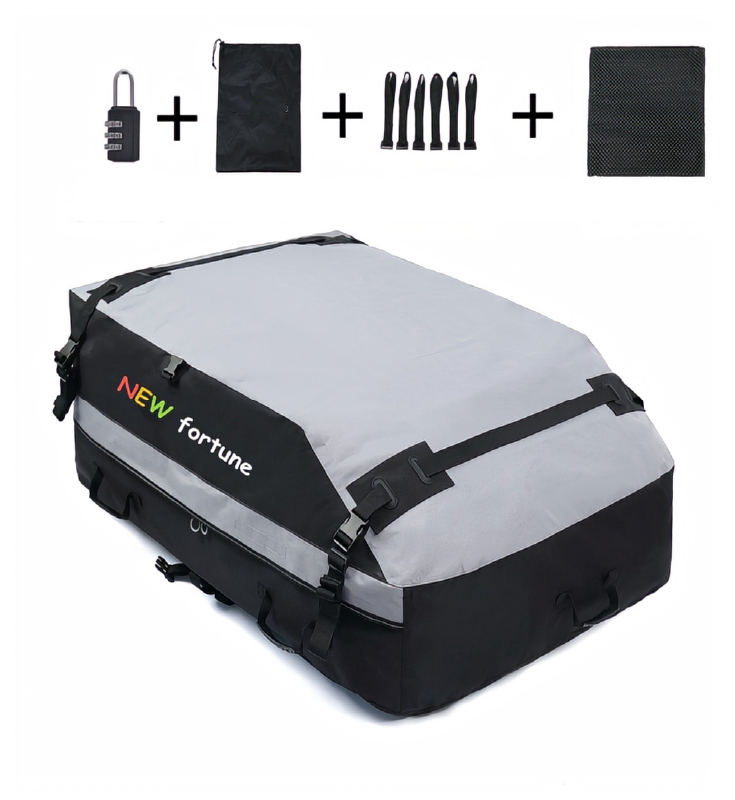
A car carrier roof bag recovers that lost space, adding 11 to 25 cubic feet above the roofline at a fraction of the cost of a hard-shell rooftop box. The selection process comes down to three engineering decisions: capacity, material, and attachment system. New Fuda Luggages & Bags Co., Ltd., a manufacturer of vehicle roof bags and outdoor luggage since 2006, builds these three parameters into every carrier it produces. This guide explains how each one affects real performance, so you can match a roof bag to your vehicle, your cargo, and your driving conditions.
Match a roof bag's rated cubic feet to the cargo you actually carry, not to the length of your vehicle. Roof bags span 11 to 25 cubic feet (310 to 710 liters), and the rating assumes the bag is packed full with the zipper closed. A 15-cubic-foot model genuinely holds two checked-size cases and a weekend duffel. Under-pack a large bag and the fabric flutters; over-pack it and the zipper seam carries the load, which is the most common failure point on any car roof bag.
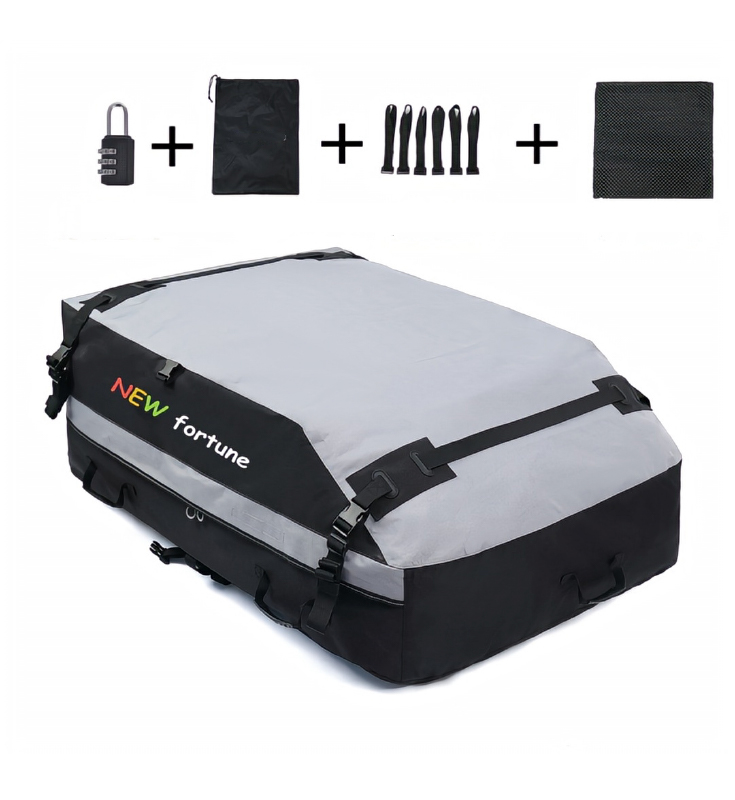 FO-22 Jeep Roof Cargo Bag, 19 Cubic Feet Waterproof CarrierThis 19-cubic-foot roof bag suits travelers who regularly carry bulky gear like folding chairs or fishing rods. Its lightweight 3.56 kg build and protective pads make fitting and loading straightforward for outdoor trips.View Product →
If your regular cargo includes folding chairs, fishing rods, or a soft cooler, step up one size. A roof bag's empty weight is typically 4 to 6 kg, so the bag itself adds little mass; the load you place inside is what matters. For a more detailed method, how to choose a car roof storage bag by load capacity walks through measuring your actual luggage stack before ordering.
Fabric weight, coating, and seam construction, not brand names, determine whether a roof bag survives highway wind, heavy rain, and years of UV exposure. Two material families dominate the market, and each supports a different travel profile.
Denier measures thread weight, not durability. A dense 500D weave can outperform a loose 600D weave. The coating layers, seam method, and zipper specification matter more than the fabric number alone.
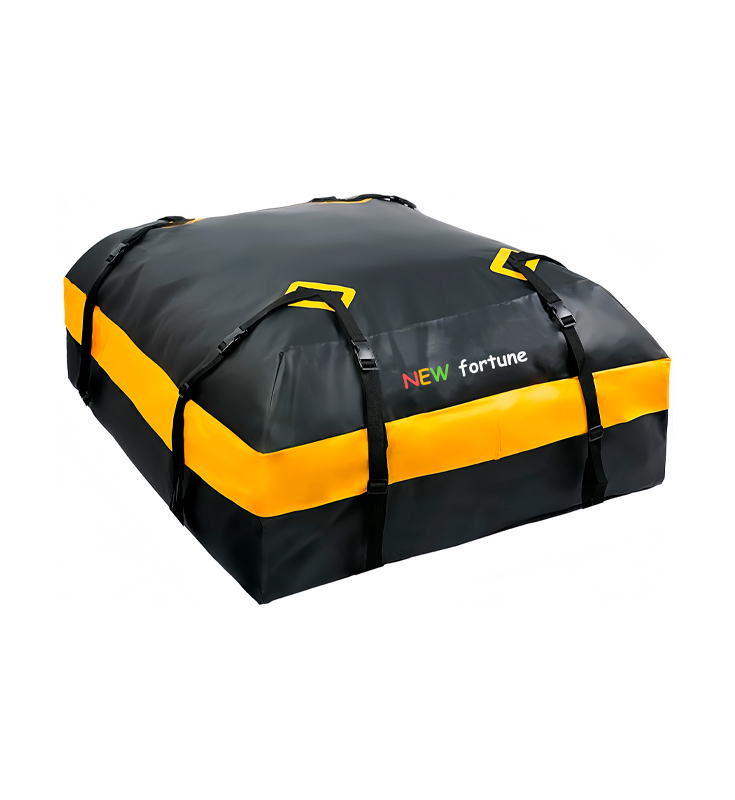 FO-10 Waterproof 15 Cubic Feet 500D Grid PVC Roof BagAt 15 cubic feet and 2.1 kg, this bag balances capacity and ease of handling. The dense 500D grid PVC and heat-sealed seams address durability concerns before you consider how it attaches to various roof styles.View Product →
| Property | PVC-coated polyester | Oxford cloth with PU coating |
| Water resistance | Fully waterproof | Water-resistant, coating wears with flexing |
| Typical denier | 500D-600D | 420D-600D |
| Weight | Heavier, more rigid | Lightweight, packs small |
| Abrasion resistance | High | Moderate |
| Seam compatibility | Welded or stitched with taping | Stitched with seam tape |
| Best use case | Long trips, harsh weather | City travel, occasional use |
A roof bag is only as safe as its attachment method; the most reliable designs combine full-wrap straps, an anti-slip mat, and load-rated buckles. Universal models must handle both roofs with crossbars and smooth roof panels with no mounting points at all.
Most universal roof bags are built for no-rack mounting. The strap runs vertically through the door opening, sits below the weather seal, and the buckle tightens inside the cabin. This works on sedans, SUVs, and hatchbacks, provided the straps are positioned at the factory-marked points instead of wherever they happen to fall.
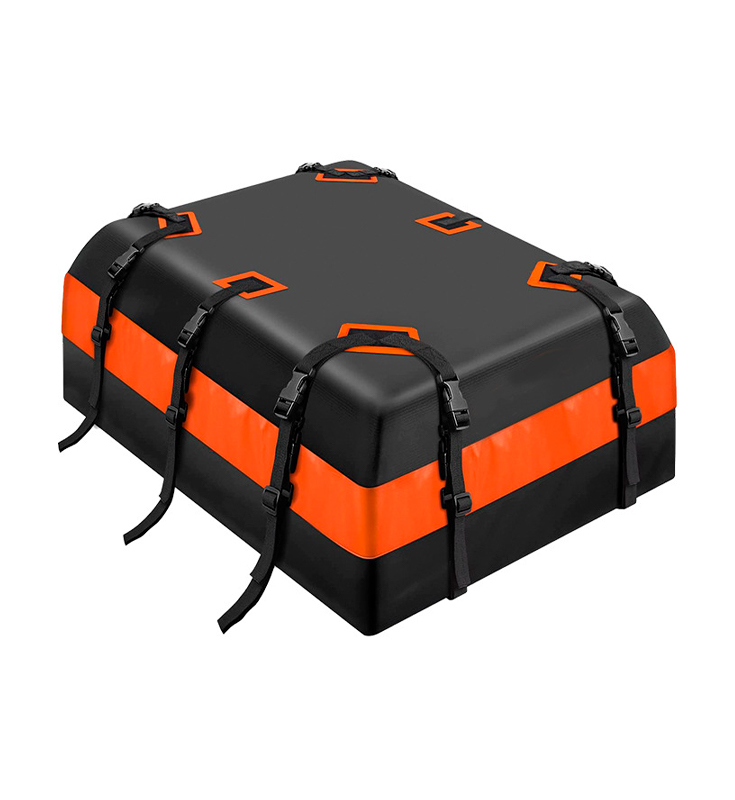 FO-1 Waterproof Soft Rooftop Cargo Bag with Safety Lock, 21 Cubic FeetThis 21-cubic-foot soft bag fits no-rack roofs through door-hook straps and a safety lock. Its 500D grid PVC, heat-sealed seams, and 2.35 kg weight make it a practical choice for first-time rooftop cargo users.View Product →
Correct installation takes six steps and roughly fifteen minutes the first time you do it. The sequence below follows the same procedure New Fuda uses when testing prototype roof bags on actual vehicles.
Total rooftop load, speed, and packing order decide whether a roof bag arrives intact. The bag itself is rarely the weakest link; the vehicle's roof limit and the driver's habits are.
Yes. Universal roof bags route straps through the door openings and close them inside the cabin. An anti-slip mat and door-edge protectors are required, and the strap must lie flat below the weather seal.
The vehicle's roof load limit is the binding constraint, typically 50 to 60 kg on bare roofs and up to 75 kg with a rack. The bag itself is rarely the weak link when it is properly rated and tensioned.
Five cubic feet is roughly 140 liters, about one large suitcase. Choose 15 cubic feet for two travelers' luggage and step up to 20 for a family of four.
Yes, when the seams are welded or taped and the zipper is covered by a rain flap. Keep speed below 110 km/h, retighten the straps after the first 30 minutes, and the bag will hold through sustained rain.
Your email address will not be published. Required fields are marked *
* Your email is safe with us, we don't spam.

Professional R & D and manufacturing of outdoor sports, cycling, fishing, business, travelling sewing, high-frequency stamping series of luggage enterprises
E-mail: christine@fudabags.com
Phone: +86-13819351116
Add: No.2288 Xinggong Road, Pinghu City, Jiaxing City, Zhejiang Province, China
Copyright © 2025 by New Fuda Luggages & Bags Co., Ltd. Rights Reserved. Privacy Custom Durable Outdoor Travel Bag Manufacturers


 English
 Français
 Español