


Get A Quote

Content
Sourcing a small soft cooler for a production run comes down to a specification sheet, whether you write it yourself or accept the factory's default. A compact portable cooler, typically 5 to 15 litres, must balance insulation, leak resistance, packed weight and unit cost, and each of those properties is locked in by specific material and construction choices. Buyers who cannot read these specifications end up with an overpriced bag that underperforms or a cheap unit that returns as warranty claims.
A small soft cooler's capacity specification must pair the litre rating with interior dimensions, because the same nominal volume can vary widely in usable space depending on foam thickness and construction. A 12-litre unit with thick insulation holds less packed food than a 12-litre thin-walled unit, so always request interior size and shape before comparing models.
Small soft coolers cover three practical ranges: 5-8 litre units suit personal meals and single-day trips, 9-12 litre units handle couples' picnics and short fishing sessions, and 13-15 litre units support small-family outings and boat days. Exterior dimensions matter as much as litres, because the cooler must fit a car boot, a boat deck or a bike pannier, and sizing affects how many units fit in a shipping carton.
| Capacity range | Typical exterior size | Primary use | Empty weight |
| 5-8 L | 300 x 200 x 180 mm | Personal meals, day trips | 0.4-0.7 kg |
| 9-12 L | 350 x 240 x 220 mm | Couples, short fishing trips | 0.7-1.1 kg |
| 13-15 L | 400 x 270 x 250 mm | Picnics, boat and beach days | 1.0-1.4 kg |
A soft cooler's capacity is the usable interior volume of the insulated cavity, measured in litres, excluding external pockets, zipper folds and closure structure.
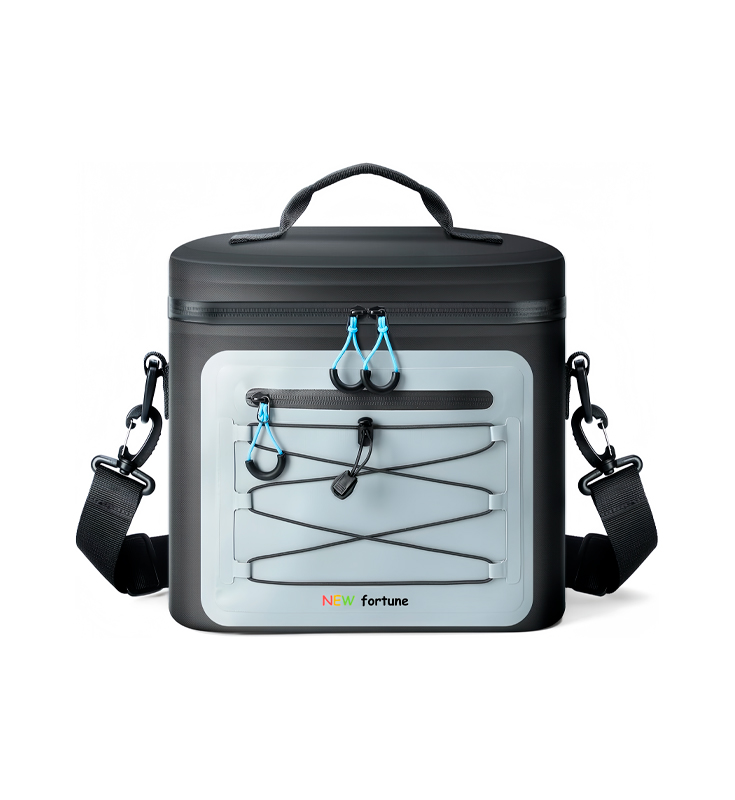
 F-013 TPU Soft Travel Cooler with Leak-Proof Waterproof ZipperThis lightweight TPU cooler offers two sizes holding 18 or 24 cans, with EPE/EVA insulation and a waterproof zipper. It suits campers needing a compact, dependable cold storage option.View Product →
A small soft cooler's ice retention is set by three variables: insulation thickness, closure integrity and the mass of cold content loaded inside. No welding technique can compensate for a thin bottom panel or an unsealed zipper, so insulation must be evaluated as a complete system around the cavity.
Quality small soft coolers hold ice for 18-24 hours at 30 C ambient with a standard ice-to-content ratio. The insulation layer is typically closed-cell EVA or PU foam, 10 to 20 mm thick, wrapped around all six faces of the cavity; budget designs often thin the bottom panel, which sits directly on warm surfaces. A welded TPU shell supports insulation because it removes the needle holes that stitching creates, and every stitch line is simultaneously a thermal bridge and a leak path.
Buyers should request the factory's ice-retention test protocol and compare results on equal terms: identical payload, starting temperature and ambient conditions. The TPU cooler bag ice retention performance guide explains how these tests are structured and which results are worth trusting.
TPU is the default material specification for a portable soft cooler because it combines leak resistance, low-temperature flexibility and durability in a lighter package than PVC. Thermoplastic polyurethane film is welded into a sealed cavity by high-frequency dielectric heating, producing joints with the same material character as the parent film, which makes a truly leak-proof soft cooler possible.
PVC offers similar leak resistance but weighs 30-40 percent more at the same film thickness, stiffens in cold conditions and carries a weaker environmental profile. Oxford-fabric coolers are cheaper, but their seams are stitched and their waterproofing depends on a polyethylene liner that degrades with washing. For repeated portable cooling use, TPU is the most balanced choice.
| Property | TPU | PVC | Oxford fabric |
| Leak resistance | High when welded | High when welded | Moderate, liner dependent |
| Weight at 0.5 mm film | Light | 30-40% heavier | Light, textile dependent |
| Cold flexibility | Maintains flexibility | Stiffens below -5 C | Maintains, liner dependent |
| Eco profile | Halogen-free | PVC additives | Coated textiles |
TPU film for small soft coolers is normally specified at 0.6-1.0 mm. Thinner film folds more compactly; thicker film resists punctures and repeated folding. There is no single best thickness, only a thickness matched to the intended use cycle.
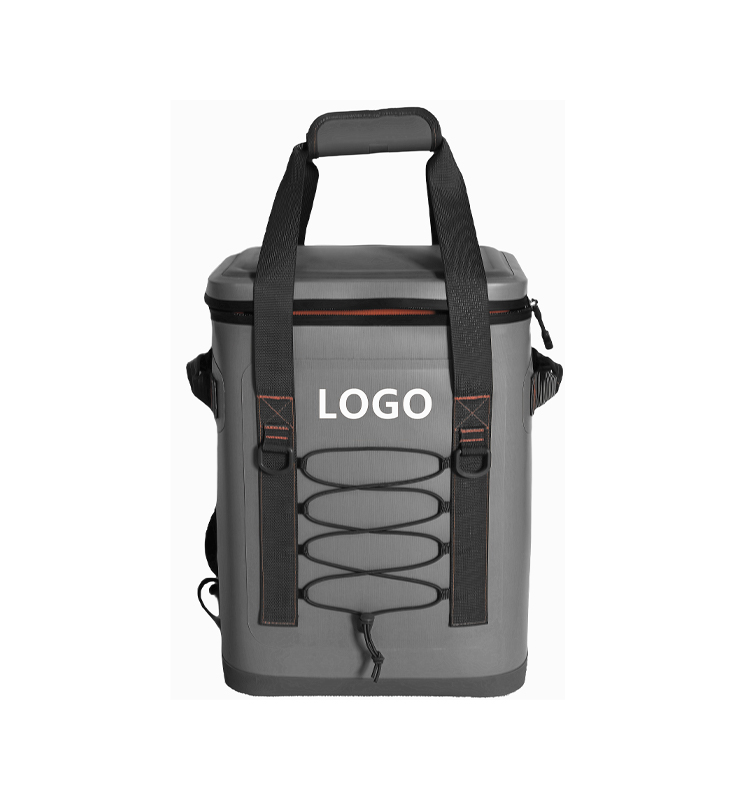
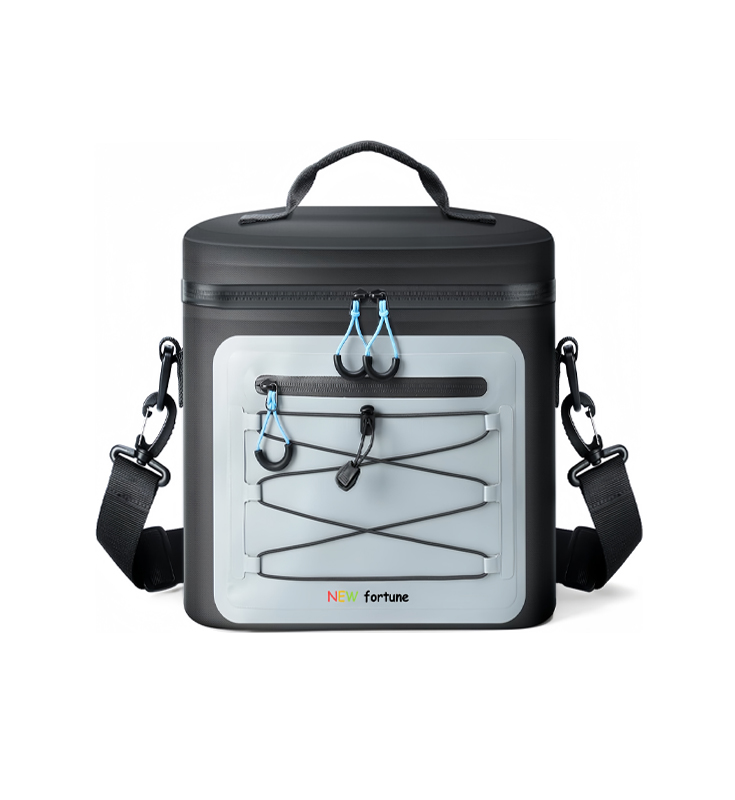 F-005 Waterproof TPU Small Soft Cooler Bag for Hiking and BoatingDesigned for active outdoor use, this lightweight TPU cooler holds 18 or 24 cans, features EPE/EVA insulation and an airtight waterproof zipper, making it suitable for hiking and boating trips.View Product →
A soft cooler fails at its joints, not through the panel fabric, so high-frequency welding and a true waterproof zipper are the two most decisive construction specifications. High-frequency welding fuses TPU panels into a monolithic structure with no stitching or adhesive, and the perimeter weld on a cooler body typically runs 15-25 mm wide.
Weld quality is verified by inflated air-pressure testing or a seam-peel test, and a proper weld shows no delamination when bent repeatedly. The zipper is the second risk point: a water-resistant coil zipper wicks moisture into the cavity, while a true waterproof zipper has a polyurethane film sealed to the zipper tape, and the tape itself is welded into the TPU panel.
A water-resistant zipper is not acceptable for a product labelled leak-proof. The specification sheet must name a true waterproof zipper, and the welding of the zipper tape into the TPU panel must be part of the factory's inspection checklist.
Portability is the reason a buyer chooses a soft cooler over a rotomoulded box, so handle geometry, strap attachment and packed weight are functional specifications. A small soft cooler carries 8-12 kg when fully loaded, and strap loops transfer that load to welded attachment zones, which spread stress across a larger area than a stitched loop.
Single-shoulder straps suit units up to 10 litres; backpack configurations work better above 12 litres because they keep the load close to the body. The opening must stay manageable when the cooler is full, and the body should not deform so much that the zipper pulls out of alignment during closure.
A rigid welded base insert keeps the cooler upright, makes packing easier and improves stability in a car boot or on a boat deck. The trade-off is extra weight and reduced foldability.
Collapses into a small space for storage and shipping, weighs less, but needs flat support and can deform under heavy loads or hot conditions.
Durability in a soft cooler is expressed in measurable terms: tear strength, UV resistance, flex-crack resistance and puncture resistance, and each value should appear on the supplier's data sheet. A TPU film with a tear strength above 80 kN/m is a sensible starting point for a product dragged across gravel, boat decks and car boots.
The worst damage happens at corners, zipper ends and the bottom panel, where folding stress and abrasion concentrate. Support blocks, corner welding and a thicker base film are the engineering answers, and these details are visible when the buyer inspects a sample.
A quality TPU soft cooler should survive more than 5,000 folding cycles and continuous outdoor sunlight without surface cracking. These two properties alone separate a factory that tests its materials from one that only assembles them.
Five specifications should be confirmed in writing before a small soft cooler order goes into production: insulation thickness, TPU film grade, zipper specification, weld width and the leak-test standard. New Fuda Luggages & Bags Co., Ltd., a manufacturer combining high-frequency welding and sewing capability, lists exactly these parameters on its production cards for custom cooler programs, and naming all five in the purchase order removes most of the ambiguity that leads to field failures.
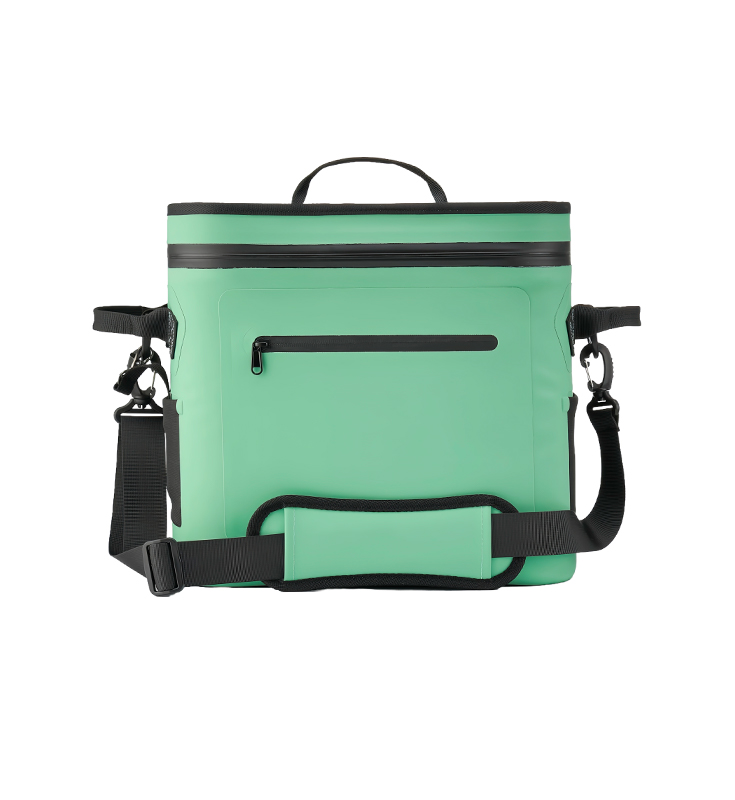
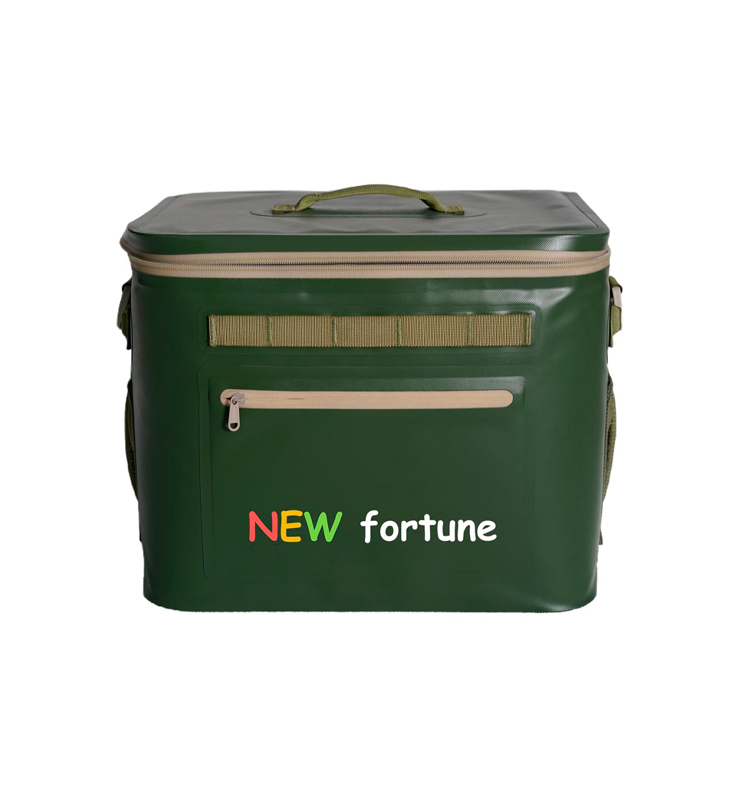 F-025 Foldable TPU Soft Cooler with Large Capacity and Waterproof ZipperWith a 40-can capacity and durable TPU construction, this foldable cooler provides ample insulation for parties or family travel, featuring an airtight waterproof zipper for reliable dry storage in wet conditions.View Product →
A 9-12 litre unit covers most daily scenarios: two packed meals, four cold drinks and an ice pack, with enough insulation volume to hold temperature for 6-8 hours of active use. This size stays comfortable on a single-shoulder strap.
With 15 mm of closed-cell foam and a welded TPU shell, a 10-litre cooler typically keeps ice for 18-24 hours at 30 C ambient. Heavier ice loads, pre-chilled contents and a fully sealed zipper push this toward the top of the range.
For day-use boating and fishing, a soft cooler replaces a hard box in most cases: it stores flat, weighs less and absorbs deck contact without denting. For multi-day trips with large ice blocks, a hard cooler still leads on total ice capacity and crush resistance.
Leak resistance of the welded seams is the specification that separates a reusable product from a disposable one. Verify weld width, waterproof zipper type and the factory's leak-test standard before ordering.
Your email address will not be published. Required fields are marked *
* Your email is safe with us, we don't spam.

Professional R & D and manufacturing of outdoor sports, cycling, fishing, business, travelling sewing, high-frequency stamping series of luggage enterprises
E-mail: christine@fudabags.com
Phone: +86-13819351116
Add: No.2288 Xinggong Road, Pinghu City, Jiaxing City, Zhejiang Province, China
Copyright © 2025 by New Fuda Luggages & Bags Co., Ltd. Rights Reserved. Privacy Custom Durable Outdoor Travel Bag Manufacturers


 English
 Français
 Español