


Get A Quote

Content
The TPU cooler bag has evolved from a simple insulated container into a performance-engineered product, essential for fishing, cycling, and specialized travel where prolonged cold retention is mandatory. For B2B procurement in the outdoor industry, performance is quantified by the bag's ability to resist heat transfer—a metric defined by the thermal transmittance coefficient, or U-value. Achieving a sustained internal temperature below ten degrees Celsius for over 48 hours in a challenging thirty degrees Celsius ambient environment requires minimizing heat gain through the bag's composite structure, insulation core, and seals. New Fuda Luggages & Bags Co., Ltd., established in 2006, specializes in manufacturing high-performance outdoor products. Our expertise spans both traditional sewing and advanced high frequency welding for soft cooler insulation, allowing us to engineer bags that meet extreme cold retention metrics. Our commitment to product quality and research has positioned us as a preferred supplier for specialized bags exported to Europe, America, and Japan.
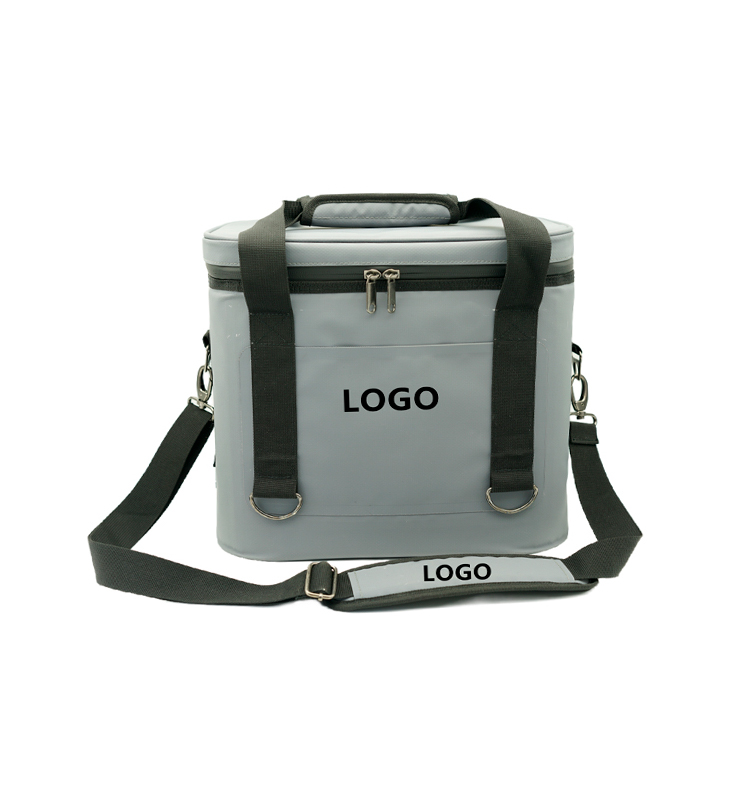
F-001 Gray Single Shoulder Handbag Tpu Portable Soft Cooler With Customizable logo
Thermal transmittance (U-value) measures the rate of heat flow through a structure per unit area, expressed in Watts per square meter Kelvin (W/m²·K). A lower U-value signifies superior insulation. The overall U-value of a TPU cooler bag is the reciprocal of the total thermal resistance (R-value) of its multi-layered wall structure, which includes the TPU shell, the insulation, and the internal liner. The calculation requires accounting for the thermal conductivity ($k$) and thickness ($L$) of each layer, a core component of the TPU cooler bag U-value calculation.
The choice of the insulation core material is the most critical factor influencing the final U-value. PU (polyurethane) foam is typically produced with a low-conductivity blowing agent trapped in its closed-cell structure, providing excellent thermal resistance. EVA (Ethylene-Vinyl Acetate) foam, while offering superior flexibility and impact resistance, generally has a higher thermal conductivity. For the longest ice retention time soft cooler bag, a high-density, closed-cell PU foam offers the best PU foam vs EVA foam cooler insulation efficiency, though often requiring a semi-rigid design to protect the structure.
| Insulation Material | Typical Thermal Conductivity ($k$ value in W/(m·K)) | Primary Advantage | Trade-off in PU foam vs EVA foam cooler insulation efficiency |
|---|---|---|---|
| Polyurethane (PU) Foam | 0.021 – 0.030 | Lowest thermal conductivity, superior R-value per unit thickness. | Less flexible; requires more specialized, rigid construction. |
| Ethylene-Vinyl Acetate (EVA) Foam | 0.035 – 0.045 | High flexibility, excellent impact resistance and cushion. | Higher thermal conductivity; requires greater thickness for equivalent R-value. |
Given a material's thermal conductivity ($k$), the R-value ($R = L/k$) is directly proportional to its thickness ($L$). Therefore, the simplest way to lower the TPU cooler bag U-value calculation is to increase the thickness of the insulation layer. For a typical soft cooler, increasing the wall thickness from eighteen millimeters to thirty millimeters (using the same $k$-value material) will nearly double the thermal resistance, directly extending the ice retention time soft cooler bag.
Even with the thickest insulation, the presence of "thermal bridges"—areas where heat can bypass the insulation layer—will drastically reduce the overall cold retention performance. In soft coolers, the seams and the closure zipper are the main culprits. The use of high frequency welding for soft cooler insulation is crucial. This advanced technology uses electromagnetic energy to fuse the thermoplastic materials (TPU shell, internal liner) without requiring needle punctures. Traditional sewing methods introduce thousands of tiny perforations, each acting as a heat bridge and a water ingress point. High-frequency welding eliminates these bridges, ensuring the insulation is completely enclosed and dry, which is essential as moisture infiltration drastically increases the $k$-value of the foam.
| Assembly Method | Seam Integrity | Heat Transfer Mitigation | Performance Impact on TPU cooler bag |
|---|---|---|---|
| Sewing (Traditional) | Water and air permeable; requires seam-sealing tape. | Needle perforations create multiple thermal bridges. | Lower ice retention time soft cooler bag due to heat and moisture gain. |
| High Frequency Welding | Airtight and waterproof fusion; no needle holes. | Eliminates thermal bridges through the seams. | Superior cold retention and overall durability. |
To verify the claim of internal temperature remaining at or below ten degrees Celsius for 48 hours under thirty degrees Celsius ambient conditions, a standardized cold retention performance testing protocol is mandatory for B2B certification. This test, often referred to as the Figure of Merit (FoM) test, must be conducted in a controlled climate chamber.
This rigorous cold retention performance testing protocol ensures that the calculated low U-value translates directly into the required real-world performance, verifying the ice retention time soft cooler bag for the end-user.
Achieving exceptional cold retention in a TPU cooler bag is an exercise in applied thermal engineering. Success hinges on a low TPU cooler bag U-value calculation, achieved through thick, low-$k$ insulation (like PU foam), and the structural integrity provided by high frequency welding for soft cooler insulation to eliminate heat bridges. New Fuda Luggages & Bags Co., Ltd. applies this engineering rigor across our product line, ensuring that our outdoor bags consistently deliver the certified ice retention time soft cooler bag and the robust performance demanded by international B2B customers.
Your email address will not be published. Required fields are marked *

* Your email is safe with us, we don't spam.

Professional R & D and manufacturing of outdoor sports, cycling, fishing, business, travelling sewing, high-frequency stamping series of luggage enterprises
E-mail: christine@fudabags.com
Phone: +86-13819351116
Add: No.2288 Xinggong Road, Pinghu City, Jiaxing City, Zhejiang Province, China
Copyright © 2025 by New Fuda Luggages & Bags Co., Ltd. Rights Reserved. Privacy Custom Durable Outdoor Travel Bag Manufacturers


 English
 Français
 Español