


Get A Quote

Content
In the high-stakes world of offshore competitive fishing, the preservation of catch quality is not merely an aesthetic concern but a critical factor in tournament weight and commercial value. A high-performance fish kill bag cooler must provide superior thermal retention and structural integrity to accommodate the specific morphologies of apex predators. New Fuda Luggages & Bags Co., Ltd., established in 2006, is a leader in R&D and manufacturing of technical outdoor and fishing gear. Utilizing advanced sewing and high-frequency welding technologies, we have become the preferred supplier for global cross-border sellers, specializing in heavy duty leakproof fish bags that meet the rigorous demands of the European, American, and Japanese markets.
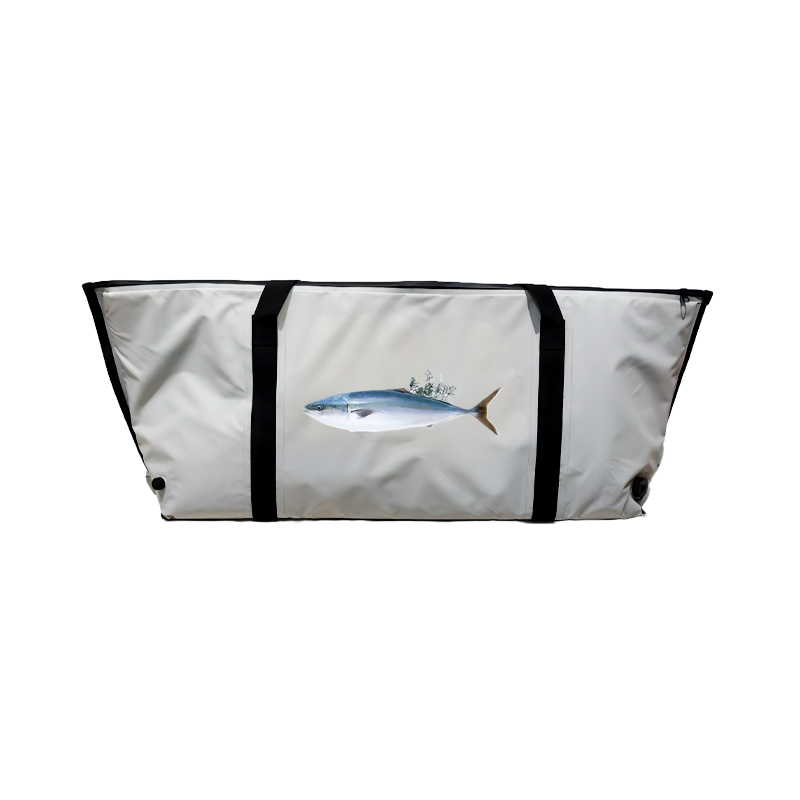
The primary engineering challenge when selecting insulated fishing bags for offshore boats lies in the anatomical differences between Kingfish (Scomberomorus cavalla) and Tuna (Thunnus spp.). Kingfish are characterized by an elongated, slender profile requiring bags with significant horizontal span, whereas Tuna possess a fusiform, high-girth body plan that necessitates a bag with a wide gusseted base to prevent crushing and maintain core temperature. While a Kingfish bag focuses on linear dimensions to prevent tail-folding, a Tuna bag requires volumetric capacity to allow for sufficient ice-to-fish contact around the midsection.
| Fish Species | Primary Dimension Focus | Critical Capacity Metric | Recommended Design |
| Kingfish | Length (Up to 60-72 inches) | Aspect Ratio (Long/Narrow) | Flat-profile elongated bag |
| Tuna (Yellowfin/Bluefin) | Girth/Width | Volumetric Displacement | Wide-bottom gusseted bag |
To maintain "tournament-grade" freshness, the large capacity insulated fish bag must utilize closed-cell foam insulation. This material is superior to open-cell alternatives because it does not absorb moisture, maintaining its R-value throughout the voyage. In commercial grade fish cooler bags, the insulation thickness usually ranges from 12mm to 20mm. A Tuna bag requires denser insulation due to the higher metabolic heat of the fish and the longer cooling duration required for high-mass carcasses, whereas Kingfish bags prioritize portability while maintaining a steady 0°C environment.
| Feature | Standard Consumer Bag | Professional Fish Kill Bag Cooler |
| Insulation Type | Open-cell / PE Foam | High-density Closed-cell Foam |
| Seaming Technology | Standard Stitching | High-Frequency (HF) Welded Leaktight seams |
| Ice Retention Time | 12-24 Hours | 48-72 Hours (Species Dependent) |
The weight of a trophy Tuna or a limit of Kingfish can exceed 200 lbs, placing immense stress on the bag's handles and seams. New Fuda Luggages & Bags Co., Ltd. employs high-frequency pressing technology to create a molecular bond at the seams, ensuring UV resistant fish kill bags for boats remain leakproof even under high internal pressure. Furthermore, using a portable kill bag for tournament fishing requires reinforced webbing handles that wrap around the entire circumference of the bag to distribute load and prevent tearing during lifting from the deck to the weigh-in station.
When selecting your fish kill bag cooler, use the following capacity estimates to ensure adequate ice-to-fish ratios (recommended 1:2 or 1:3 ice-to-fish weight for long trips).
| Bag Size (Inches) | Estimated Capacity | Ideal Catch Profile |
| 20" x 48" | 70 - 100 Quarts | Schoolie Kingfish, Snapper, Mahi-Mahi |
| 24" x 60" | 140 - 160 Quarts | Tournament Kingfish, Small Yellowfin |
| 30" x 72" | 250+ Quarts | Bigeye Tuna, Bluefin, Large Wahoo |
This specification sheet defines the mechanical and thermal parameters for the heavy duty leakproof fish bags manufactured by New Fuda Luggages & Bags Co., Ltd. Our "Pressing Series" utilizes molecular bonding via high-frequency welding to ensure zero leakage and maximum R-value retention.
The exterior and interior skins are engineered to withstand the abrasive nature of fish scales and the corrosive environment of salt spray. Unlike standard polyester, our 1000D PVC tarpaulin offers superior puncture resistance and tensile strength.
| Component | Material Specification | Engineering Benefit |
| Outer Shell | 1000D PVC Tarpaulin (850 GSM) | UV resistant fish kill bags for boats; Puncture proof. |
| Inner Lining | Food-Grade Antimicrobial PVC | Prevents bacterial cross-contamination and odors. |
| Insulation Core | 12mm - 20mm Closed-Cell NBR/PVC | Zero water absorption; constant R-Value. |
Thermal resistance is the critical metric for a large capacity insulated fish bag. By utilizing closed-cell foam, we prevent the "wicking" effect where melting ice water penetrates the insulation, which is the primary cause of thermal failure in stitched bags.
The weight of a fish kill bag cooler when fully loaded with Tuna and ice can exceed 300 lbs. Our load-bearing architecture is designed to distribute this weight across the entire fabric body, not just the stitch points.
| Technical Metric | Standard / Method | Performance Value |
| Handle Tensile Strength | ASTM D5034 (Grab Test) | > 450 lbs (Reinforced Wrap-around) |
| Seam Burst Pressure | ISO 13935-2 | Equal to base fabric strength (Molecular bond) |
| Zipper Hardware | Salt Spray Test (ASTM B117) | 96 Hours - No Corrosion (Oversized Nylon) |
Since 2006, New Fuda has adhered to a rigorous research and development process. Our facility integrates both sewing and high-frequency pressing to provide the versatility needed for portable kill bags for tournament fishing and insulated fishing bags for offshore boats. As a preferred supplier for cross-border head sellers, we ensure all products exported to Europe, America, and Japan meet REACH and RoHS environmental standards for food-contact materials.
Your email address will not be published. Required fields are marked *

* Your email is safe with us, we don't spam.

Professional R & D and manufacturing of outdoor sports, cycling, fishing, business, travelling sewing, high-frequency stamping series of luggage enterprises
E-mail: christine@fudabags.com
Phone: +86-13819351116
Add: No.2288 Xinggong Road, Pinghu City, Jiaxing City, Zhejiang Province, China
Copyright © 2025 by New Fuda Luggages & Bags Co., Ltd. Rights Reserved. Privacy Custom Durable Outdoor Travel Bag Manufacturers


 English
 Français
 Español