


Get A Quote

Content
A roof top bag sits on a vehicle roof for hundreds of kilometres, exposed to sun, rain, wind vibration, and the shifting weight of luggage. If it fails mid-trip, the consequences are not limited to damaged belongings; a loose bag on the roof is a real danger for the driver and other vehicles. That is why responsible roof top bag manufacturers treat quality as a chain of controlled decisions across the production process, not as a single inspection at the end of the line. Quality is decided by material selection, seam and weld construction, hardware sourcing, and load validation long before the finished bag reaches a carton.
The fabric a manufacturer chooses determines most of the bag's final performance. Roof bags are commonly built from PVC-coated polyester, Oxford fabric with a waterproof backing, or TPU-laminated textile. Each material family has its own balance of strength, weight, packability, and cost, so the factory has to match the material to the intended conditions of use.
The checks that matter are fabric denier, coating weight, tear strength, tensile strength, water penetration resistance, and UV behaviour. A 500D polyester with a thick PVC coating, for example, will shrug off road abrasion and heavy rain far better than a light 300D Oxford with a thin coating. A thin coating keeps the initial cost down, but it cracks or peels after a season of strong sun. That is why our production process specifies the material for every order and tests incoming rolls instead of trusting a supplier's label. The same reasoning sits behind our heavy-duty 500D PVC car roof box, which is specified for trips where weather and road conditions are demanding.
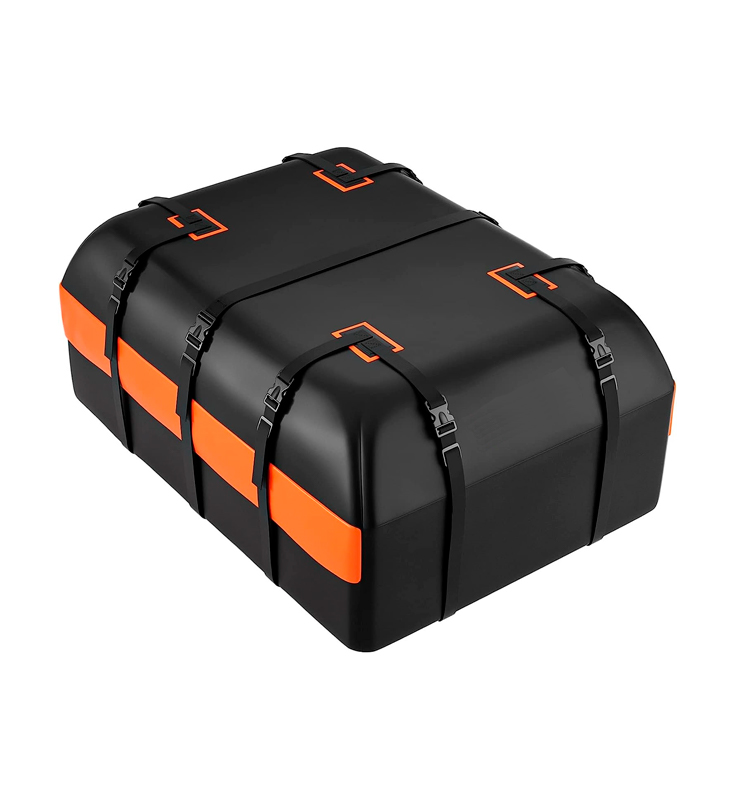
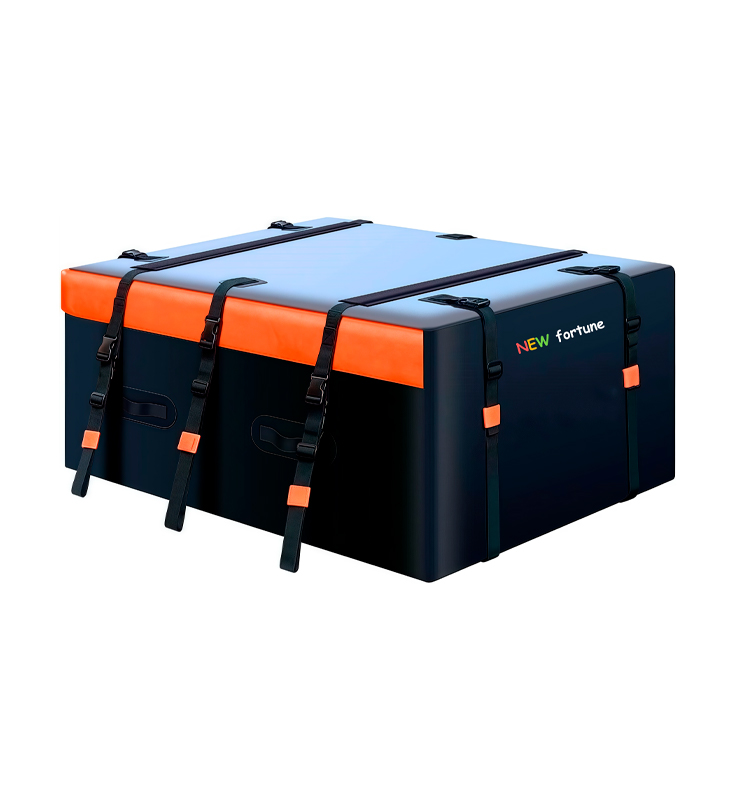 Wholesale Private Label FO-9 Heavy-duty Large Capacity 500D Durable Waterproof PNew Fuda Luggages & Bags Co., Ltd is China Wholesale Private Label FO-9 Heavy-duty Large Capacity 500D Durable Waterproof PVC Car Roof Bo...View Product →
The performance shown in product photos only lasts if the base material matches the sales claim. A bag that feels dense and firm in the hand is usually carrying a heavier coating or a stronger base fabric, which is a good sign in a roof top bag. What buyers should confirm is that the manufacturer can show a material specification sheet and test records for the production batch, not only for an early sample. A useful background is our assessment of durability and performance of outdoor car roof luggage bags, which explains how material choices translate into real service life.
Once materials are approved, the construction method becomes the next quality battleground. A roof bag may be sewn, welded, or built with a combination of both, and each technique carries its own risks.
The panels of a roof bag are joined by sewing, and the seams are the weakest part unless the process is tightly controlled. The factory has to manage stitch density, thread type, seam allowance, needle size, and thread tension. Bonded polyester or nylon thread resists abrasion and moisture far better than ordinary sewing thread. High-stress points such as strap anchors, webbing loops, and zipper ends need reinforcement in the form of bartacks or box-X stitching. An experienced inspector checks more than the straightness of a seam; even thread tension and a consistent seam allowance are equally important. A seam that looks neat can still fail early when these settings drift.
For roof bags sold as fully waterproof, high-frequency welding is often the preferred method. The machine presses and heats PVC or TPU layers together to form a continuous weld line that keeps water out. The operator must control weld width, power output, pressing time, and cooling time, because each parameter has a direct effect on weld strength and appearance. In production, manufacturers test welded seams with peel tests and check finished bags under a water spray or air pressure test. Since high-frequency welding is fundamentally different from sewing, a serious factory keeps the two lines separate so each process can be inspected with its own criteria.
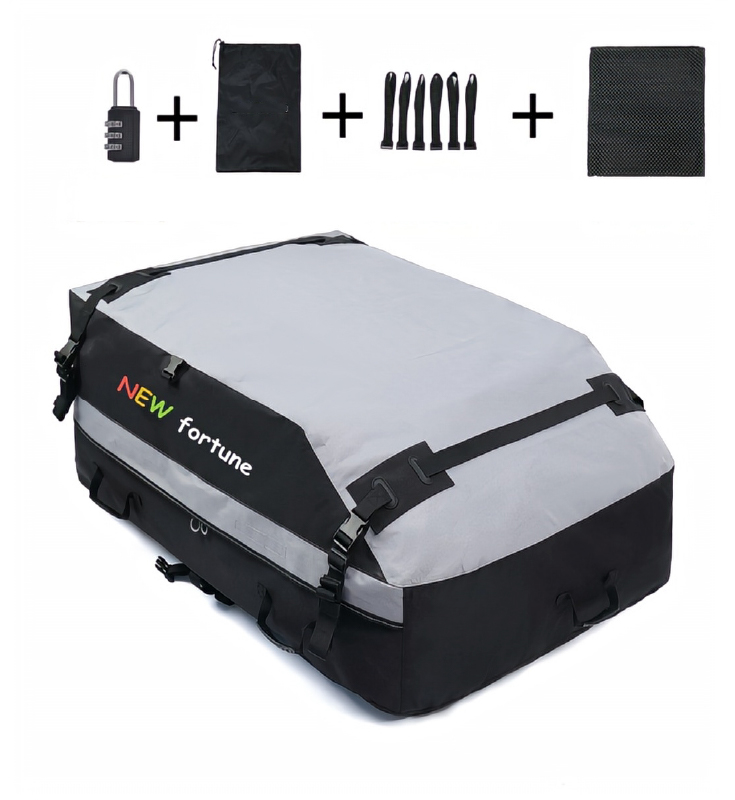
Zippers are usually the first part of a roof bag to wear out. Weak zipper tape or poor sliders will fail after a few dozen open-close cycles. A well-made bag uses large double-slider zippers, often protected by a waterproof flap, and the zipper should be tested through hundreds of cycles. Straps and buckles need the same attention. Webbing straps must have a rated breaking strength, buckles should be moulded from impact-resistant nylon, and any metal parts must be free of burrs and metal fatigue risk. The anti-slip mat on the underside of many roof bags is another detail that decides safety: it must keep its grip after heat and UV exposure, or the bag can slide across the roof panel. Our large-capacity roof bag with anti-slip mat uses a PVC friction layer that holds its position even on smooth painted roofs.
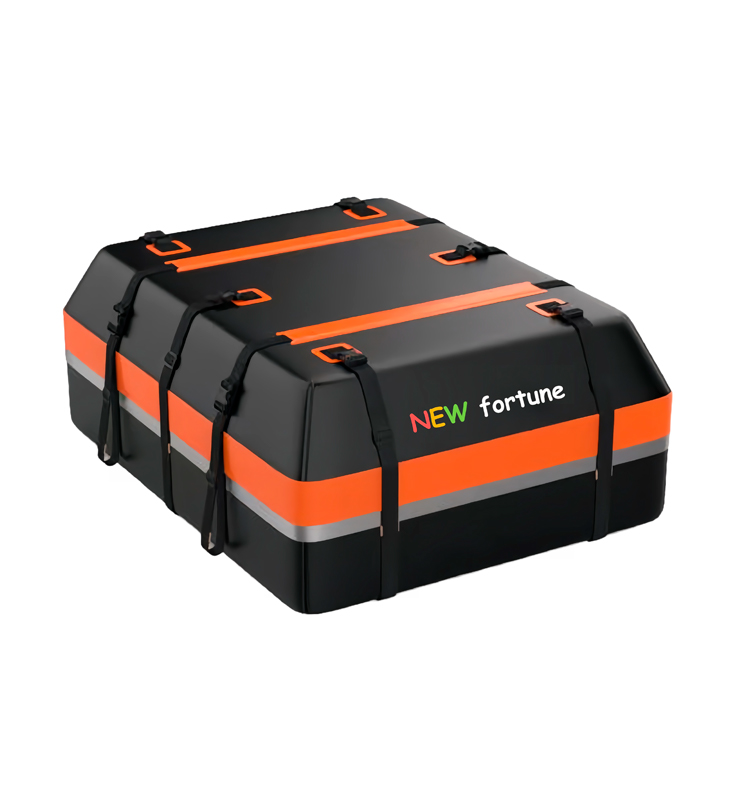 Wholesale Private Label FO-14 Large Capacity Universal Waterproof Car Roof CargoNew Fuda Luggages & Bags Co., Ltd is China Wholesale Private Label FO-14 Large Capacity Universal Waterproof Car Roof Cargo Luggage Carri...View Product →
The capacity printed on a roof bag is a promise that must be repeatable in production. A reliable manufacturer validates it with both static and dynamic tests. In a static load test, the bag is filled to a defined weight and held for a set period, then checked for seam movement, strap stretch, and zipper stress. In a dynamic test, the loaded bag is placed on a vibration rig that simulates hours of driving, then inspected for failures. Water resistance is verified separately with a spray test or by measuring the hydrostatic head of the fabric.
| Check Point | What Is Tested | Why It Matters |
|---|---|---|
| Incoming material | Denier, coating weight, tear strength, hydrostatic head | A weak or under-coated fabric fails before the bag reaches the customer |
| Weld seam | Peel strength, pinholes, line continuity | Poor high-frequency welding causes leaks and delamination |
| Strap anchor | Bartack coverage, stitch density | Strap detachment is a safety risk at highway speed |
| Zipper | Open-close cycles, slider pull force | Zipper failure is the most common field complaint |
| Load rating | Static and dynamic load test | The printed capacity number must be reproducible |
| Water resistance | Spray test, seam seal check | Water entering the bag damages luggage |
For bulky or heavy luggage, a heavy-duty rooftop cargo carrier storage bag is built with stronger base material and extra anchor reinforcement, and it is tested under the same discipline. Buyers who need a practical reference for sizing can read our car roof storage bag load capacity guide before they finalize a specification.
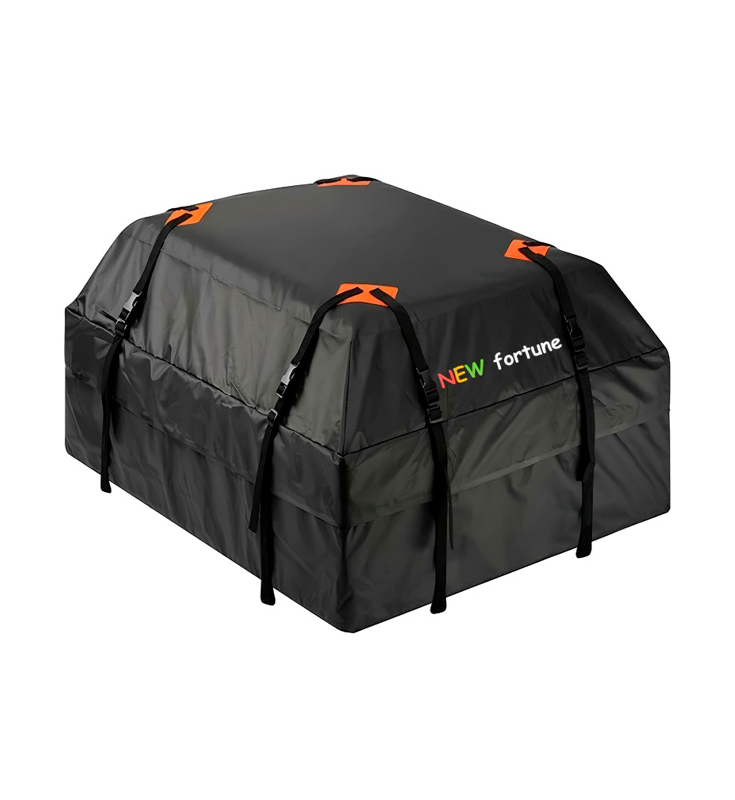 Wholesale Private Label FO-2 Waterproof Rooftop Bags, Heavy Duty Rooftop LuggageNew Fuda Luggages & Bags Co., Ltd is China Wholesale Private Label FO-2 Waterproof Rooftop Bags, Heavy Duty Rooftop Luggage Bag For Car R...View Product →
Material approval alone does not guarantee a clean production run. Most roof bag manufacturers operate with four checkpoints: incoming quality control, in-process checks during cutting and sewing, final inspection of finished bags, and pre-shipment sampling. The in-process stage matters most because defects are found while they are still cheap to correct. Operators watch seam quality, thread trimming, weld edges, zipper function, and hardware attachment as bags move down the line. Final inspection adds dimensional checks, weight verification, and a functional test of every zipper and strap. Each batch is logged, so if a problem appears later, the factory can trace it back to the material lot and the production shift that made it.
Buyers do not have to live inside the factory, but they should ask the right questions before placing an order.
A well-built bag also needs correct fitting. Review our car roof bag safety installation tips for road trips, because a roof bag that is loaded or attached poorly can fail even when the manufacturing quality is excellent.
For New Fuda, quality is the first of four pillars: quality, delivery, price, and service. Since 2006, we have manufactured roof bags and other soft luggage using sewing and high-frequency welding, and we treat every order as a repeatable production task. If you are evaluating a roof top bag manufacturer, start with the material, follow the construction method, and never skip the load test. That is how quality is actually made.
Your email address will not be published. Required fields are marked *
* Your email is safe with us, we don't spam.

Professional R & D and manufacturing of outdoor sports, cycling, fishing, business, travelling sewing, high-frequency stamping series of luggage enterprises
E-mail: christine@fudabags.com
Phone: +86-13819351116
Add: No.2288 Xinggong Road, Pinghu City, Jiaxing City, Zhejiang Province, China
Copyright © 2025 by New Fuda Luggages & Bags Co., Ltd. Rights Reserved. Privacy Custom Durable Outdoor Travel Bag Manufacturers


 English
 Français
 Español