


Get A Quote

Content
Three quotes for the same 15-cubic-foot roof top bag can come from three very different suppliers. One is a trading company that promises fast delivery, one is a sewing workshop with aggressive pricing, and one is a factory that controls both sewing and high-frequency welding in-house. Price alone cannot tell you which supplier will deliver a bag that survives highway wind, heavy rain and years of folded storage. The answer comes from the manufacturer's production capability, material discipline, quality system and communication habits.
A roof top bag is a soft cargo container that typically ranges from 10 to 25 cubic feet and straps directly onto the vehicle roof. Unlike a trunk organizer or a duffel bag, it must hold its shape against aerodynamic lift, vibration, UV exposure and sudden rain. A construction defect that would be cosmetic on an ordinary bag becomes a real safety issue on a roof at highway speed. That is why reliability is not a marketing word. It is a measurable combination of four factors:
Two fundamentally different processes go into a soft roof bag. Sewing joins fabric panels with thread and carries the mechanical load. High-frequency welding fuses TPU or PVC-coated materials under heat and pressure, creating seams without needle holes. A factory that only sews can make a structurally strong bag that leaks through its seams. A factory that only welds can produce waterproof shells but may struggle with the heavy webbing, buckles and mounting loops that keep the bag attached to the rack. The most reliable roof bag manufacturers control both processes and choose the right one for each part of the product.
New Fuda Luggages & Bags Co., Ltd., a manufacturer founded in 2006, lists both sewing and high-frequency welding as core production techniques, and its product range includes car roof bags, cargo carrier bags and trunk storage bags. When you audit a candidate supplier, ask directly which processes are performed in-house and which are outsourced. The answer reveals how much control the factory actually has over quality.
Most buyers do not order catalog items. They want custom dimensions, brand labels, a specific zipper or a new colorway. A manufacturer with in-house cutting, sewing, welding and finishing can implement those changes faster and keep the process consistent across repeat orders. A trading company only forwards instructions to an unnamed factory, so every change becomes a negotiation and every repeat order becomes a gamble.
Material choice determines how long a bag keeps its shape and how well it sheds water. The most common constructions use 500D or 600D oxford polyester, PVC-coated fabric, or TPU laminates. Heavier denier generally resists abrasion better, but coating quality and seam treatment matter just as much as the fabric itself. A 500D grid PVC construction, for instance, offers good stiffness and waterproofing at a reasonable weight, which is why it appears so often in roof top bags.
Review these construction details with the supplier:
An equally important detail is how the bag stays closed. Zippers on roof bags experience vibration that can slowly work a standard slider open during a long trip. A reliable manufacturer will offer a locking mechanism or a security flap on top of the zipper. For example, a roof top bag with an integrated safety lock adds a physical barrier that keeps the main opening shut and deters casual theft when the vehicle is parked.
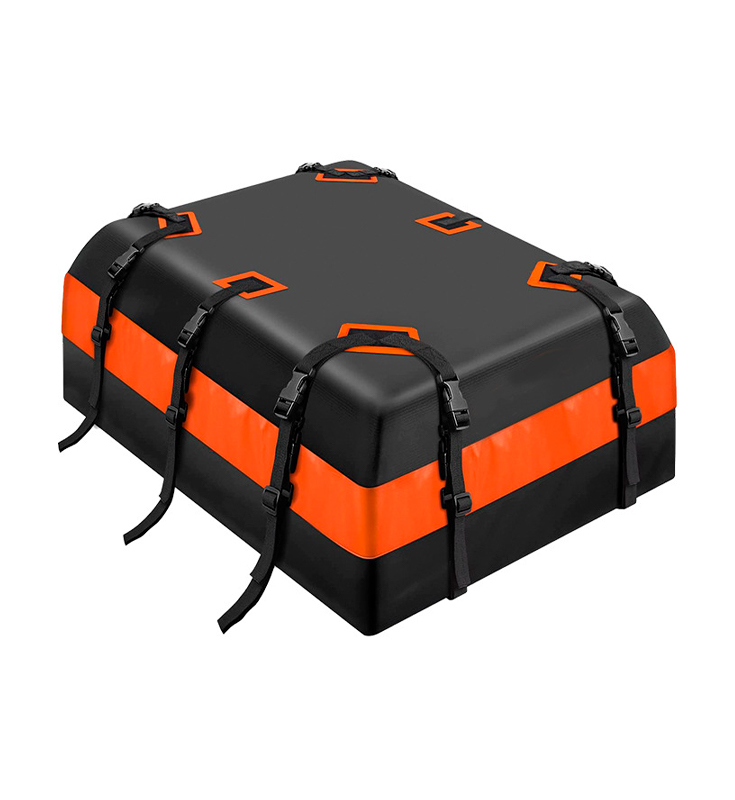 Wholesale Private Label FO-1 Waterproof Soft Rooftop Cargo Bag, Car Roof Bag WitNew Fuda Luggages & Bags Co., Ltd is China Wholesale Private Label FO-1 Waterproof Soft Rooftop Cargo Bag, Car Roof Bag With Safety Lock ...View Product →
Before you finalize the material specification, compare the two main product formats: soft roof bags versus hard-shell boxes. A soft bag is lighter, collapsible and easier to store, while a hard shell offers better rigidity and protection. The choice changes the material, the closure system and the price, so it should be made before you commit to a factory.
Every factory can claim quality, but the inspection process is what proves it. In a mature roof bag factory, the quality loop starts with incoming material inspection and ends with final random inspection before packing. Between those points, the checks that matter are the ones on the product itself: seam alignment, weld consistency, strap reinforcement and zipper function. The table below shows the checkpoints that separate a mature factory from a low-cost workshop.
| Checkpoint | What a reliable factory does | What a weak supplier skips |
|---|---|---|
| Incoming material inspection | Measures fabric denier, coating weight and zipper pull force | Uses whatever fabric arrives without checks |
| In-process inspection | Checks seam alignment, weld width and strap placement | No intermediate checks |
| Load test | Loads the bag to rated capacity, simulates vibration, inspects straps and buckles | Skips the test entirely |
| Waterproof test | Sprays the assembled bag to confirm seams and zippers hold | Visual check only |
| Final random inspection | Applies AQL sampling protocols before packing | Ships without final inspection |
Ask the factory which of these tests it can demonstrate. A supplier that keeps records of load and waterproof tests should be able to show you data for a heavy-duty rooftop cargo carrier bag before you place an order. If the answer is vague, treat it as a red flag.
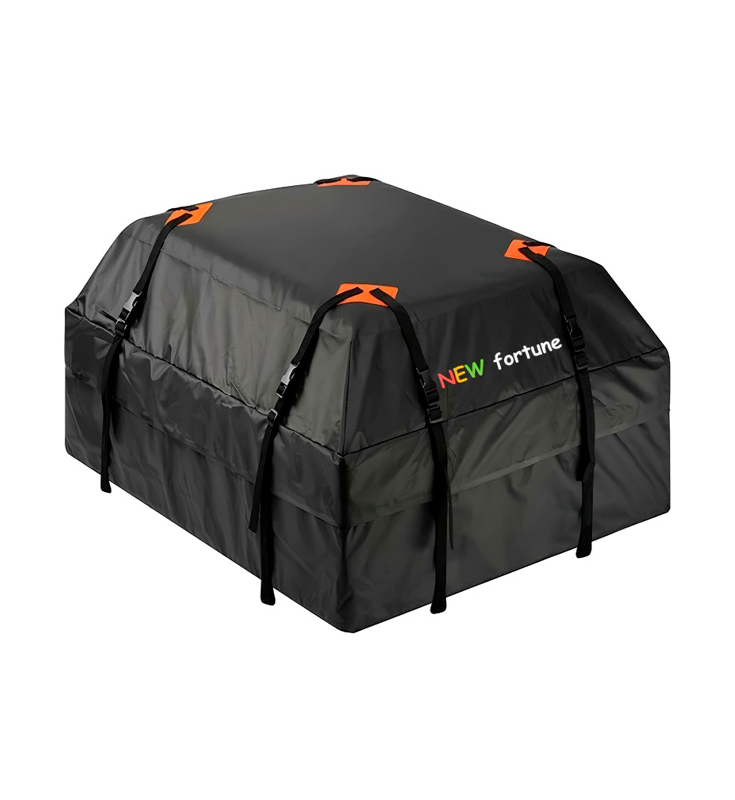 Wholesale Private Label FO-2 Waterproof Rooftop Bags, Heavy Duty Rooftop LuggageNew Fuda Luggages & Bags Co., Ltd is China Wholesale Private Label FO-2 Waterproof Rooftop Bags, Heavy Duty Rooftop Luggage Bag For Car R...View Product →
The sample is the most reliable proof of a factory's capability. When you receive a roof bag sample, inspect four things: stitch density on load-bearing areas, weld width and consistency on waterproof seams, zipper slider smoothness, and the way webbing is attached to the bag body. A good factory returns a sample within 7 to 15 days and gives you honest feedback on which requested changes are feasible and which are not. A weak supplier sends attractive photos and a sample that does not match them.
Reliable manufacturers support OEM and ODM projects with clear documentation: material specifications, packaging details, carton dimensions and inspection reports. If you need a private label, the factory should handle logo placement, swing tags and custom packaging without changing the core construction. Ask to see documentation from a recent order. A factory that keeps organized records is usually also organized on the production floor.
Custom roof bag projects are typically quoted with an MOQ of 300 to 500 pieces, depending on the number of colors and the complexity of the construction. Production lead time usually runs 30 to 45 days after sample approval, before sea freight. A reliable manufacturer is transparent about these numbers and explains what changes them. Additional colorways, custom hardware and special packaging all have a measurable effect on both price and lead time.
Volume is part of the cost discussion. A 15-cubic-foot bag fits a sedan or a compact SUV, while a 20-cubic-foot bag suits larger family cars. If you are not sure which size to specify, review load capacity guidance before you finalize the product definition, because bag size changes material consumption, packaging dimensions and shipping cost. A good middle-ground option for many brands is a 15-cubic-foot 500D grid PVC carrier roof bag, which offers enough volume for a family trip without exceeding typical roof load limits.
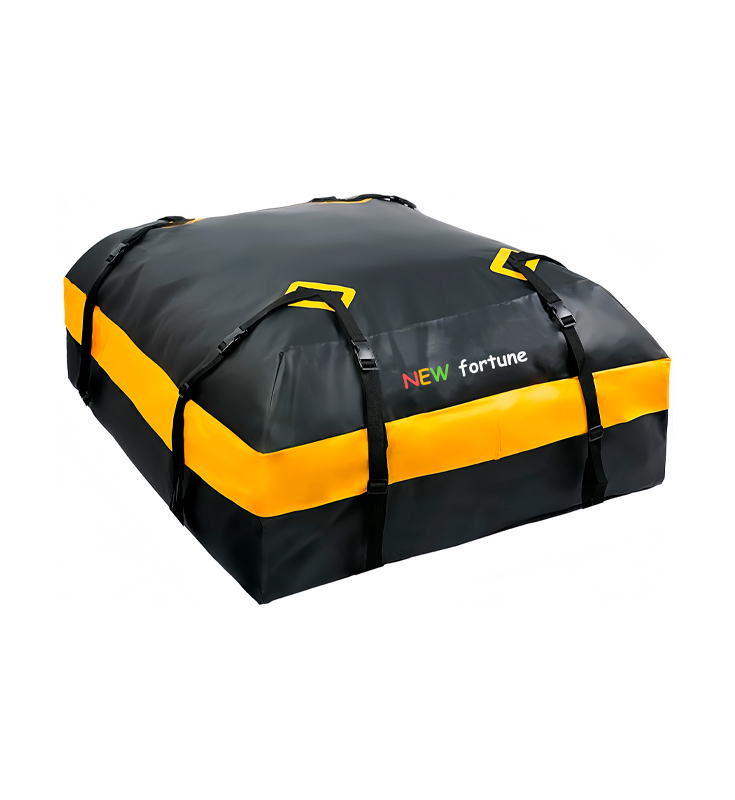 Wholesale Private Label FO-10 Waterproof 15 Cubic 500D Grid PVC Carrier Car RoofNew Fuda Luggages & Bags Co., Ltd is China Wholesale Private Label FO-10 Waterproof 15 Cubic 500D Grid PVC Carrier Car Roof Bag, SUV Roof...View Product →
Price is the last variable, not the first. A low quote usually comes from lower material grades, fewer inspection steps or weaker hardware, and those savings transfer directly into product risk. Ask for a cost breakdown that separates fabric, hardware, labor, packaging and inspection. The breakdown shows where the manufacturer saves money, and lets you decide whether saving money there is acceptable for your brand.
Communication during sampling tells you how the factory will behave during mass production. Does the supplier respond within 24 hours? Does the person answering your questions understand the production process, or are they only forwarding messages? Does the factory proactively flag material shortages or schedule changes before they become delays? These signals are as important as the sample itself.
A strong manufacturing partner also tells you when your request is not a good idea. If you ask for a lighter fabric to reduce cost, a reliable factory will warn you about the effect on wind resistance and strap stress. That honesty protects your product and your brand more than any price concession.
Roof bag quality does not end at the factory gate. The way the end user installs the bag affects both performance and safety. Send your customers practical roof bag safety installation tips, and make sure the factory's instruction sheet covers the same points.
Choosing a reliable roof top bag manufacturer comes down to verifiable evidence. In-house production, controlled materials, documented quality checks, realistic lead times and honest communication are the five areas that matter most. Start with a shortlist of factories that actually manufacture rather than trade, request samples, ask for process descriptions and compare their answers against the checklist in this article.
New Fuda Luggages & Bags Co., Ltd. has manufactured outdoor and travel bags since 2006, exports to Europe, the Americas and Japan, and produces roof top bags using both sewing and high-frequency welding. If that profile matches your sourcing requirements, request a quote with a concrete specification and see how the supplier responds. The contact process itself is a useful first test of reliability.
Your email address will not be published. Required fields are marked *

* Your email is safe with us, we don't spam.

Professional R & D and manufacturing of outdoor sports, cycling, fishing, business, travelling sewing, high-frequency stamping series of luggage enterprises
E-mail: christine@fudabags.com
Phone: +86-13819351116
Add: No.2288 Xinggong Road, Pinghu City, Jiaxing City, Zhejiang Province, China
Copyright © 2025 by New Fuda Luggages & Bags Co., Ltd. Rights Reserved. Privacy Custom Durable Outdoor Travel Bag Manufacturers


 English
 Français
 Español