


Get A Quote

Content
Wholesale buyers are drawn to roof top bags for one reason: the category sells. A foldable soft carrier that mounts on a car roof gives an online store a high-margin product with low shipping cost and none of the warehouse problems of a hard shell box. But the same product also produces one of the highest return rates in auto accessories when the specification is wrong. The buyers who lose money on roof bags are rarely the ones who paid too much per unit. They are the ones who ordered a fabric that leaked, a zipper that failed, a size that did not fit the cars in their market, or a load rating their listing could not justify.
Before you send a request for quotation, work through the sequence that protects your margin: define the end user's complaints, translate them into material and construction specs, choose a size mix that matches your vehicle park, and verify that the factory can hold the tolerances across a full production run. This guide follows that sequence.
Roof top bags compete directly with hard shell boxes. The soft bag wins on price, folded storage, and weight, and many models mount on bare roofs without crossbars. Hard boxes win on locking security and long-term weatherproofing, but they cost more and occupy warehouse space. Most households need extra roof capacity only a few weeks a year, so the foldable carrier is the rational purchase, and that logic drives a steady stream of online orders. If your product listing has to argue the case for a soft bag, review the practical comparison between soft roof bags and hard shell boxes to anchor your marketing claims in real trade-offs.
Three complaints explain most roof bag returns: water enters through seams or zippers, straps loosen or detach at highway speed, and the bag shifts, flapping against the roof and marking the paint. If you can verify only three things at the factory, verify seam construction, strap attachment reinforcement, and the anti-slip layer. Every other quality issue is secondary to these three.
The standard roof bag shell is a polyester base fabric with a PVC or PU coating. The specs buyers quote most often are 500D, 840D, and 900D grid polyester. Higher denier means more abrasion and tear resistance, but also more weight and cost. A 500D PVC-coated bag is the mainstream choice for mid-price listings; 840D and 900D suit heavy-duty positioning; TPU composites are the premium direction for better folding behavior without PVC concerns. For a wholesale order, the fabric spec should be explicit: base fabric, denier, coating type, and coating weight.
| Material | Typical weight | Waterproofness | Best positioning | Relative cost |
|---|---|---|---|---|
| 500D PVC-coated grid polyester | Moderate | High with welded seams | Mainstream value line | Lowest |
| 840D / 900D coated polyester | Heavier | High and more abrasion-resistant | Heavy-duty and commercial use | Mid |
| TPU film composite | Light | Sealed by high-frequency welding | Premium, compact folding | Highest |
Oxford cloth appears in entry-level listings. It is lighter and cheaper, but it needs a reliable coating and seam-sealed construction to justify a waterproof claim. If your market includes rainy regions, an Oxford bag without sealed seams will generate a wave of negative reviews. For buyers who want a lighter mid-tier SKU, our 20-cubic-foot Oxford cloth roof cargo bag is a reference point for weight, cost, and water resistance in a balanced configuration.
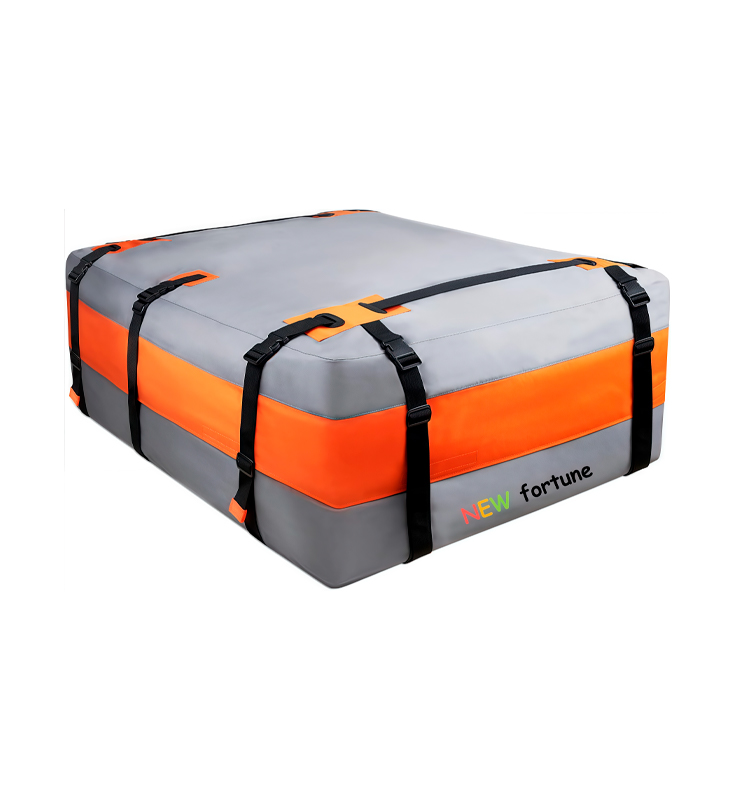 Wholesale Private Label FO-11 20 Cubic foot SUV Luggage Bag, Waterproof Oxford cNew Fuda Luggages & Bags Co., Ltd is China Wholesale Private Label FO-11 20 Cubic foot SUV Luggage Bag, Waterproof Oxford cloth Car Roof ...View Product →
Roof bag waterproofing depends more on seams and zippers than on the shell fabric. High-frequency welding fuses the material and leaves no needle holes; stitched seams should be sealed with waterproof tape on the inside. The zipper is the weakest component, so a waterproof zipper or a covered zipper flap is a spec worth paying for. Straps should be wide webbing, stitched in reinforced zones, and designed for two mounting styles: crossbar straps for cars with roof racks, and door-frame straps with clips for cars without one. An anti-slip mat is standard on better bags; it protects the roof paint and stops the bag from creeping forward under braking.
Every one of these details has a measurable tolerance. Strap stitch length, zipper water column rating, seam strength, and mat grip can all be tested. Ask the supplier to state the values in the quotation.
Roof top bags are sold by cubic feet, but the number that matters in the warehouse is the length and width of the bag relative to the cars in your market. A 15-cubic-foot bag is the most ordered size because it suits mid-size sedans and small SUVs. Compact cars are better served by 11-12 cubic foot bags. Large SUVs, vans, and family trips push buyers toward 19-25 cubic foot carriers.
Two additional dimensions belong in your spec review. The first is the bag's layout, including where the zipper runs and how the load sits above the straps. The second is the folded size, because an extra 10 cm of folded board changes your carton count and freight quote. For a mainstream value SKU, the 15-cubic-foot PVC roof carrier bag is the volume that moves fastest in cross-border channels; for larger family loads, move up a tier rather than overloading the bag. Our practical waterproof roof bag size guide explains the dimension rules in more detail.
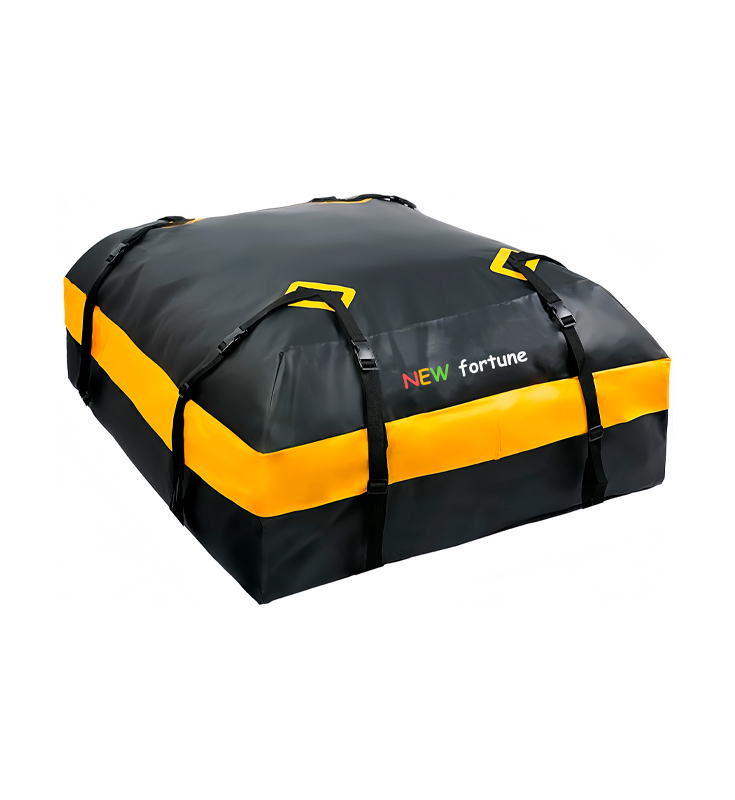 Wholesale Private Label FO-10 Waterproof 15 Cubic 500D Grid PVC Carrier Car RoofNew Fuda Luggages & Bags Co., Ltd is China Wholesale Private Label FO-10 Waterproof 15 Cubic 500D Grid PVC Carrier Car Roof Bag, SUV Roof...View Product →
A roof top bag is only as safe as the vehicle roof under it. The dynamic roof load capacity is set by the car maker, not the bag maker, and many cars have a dynamic limit between 50 and 75 kg. A 25-cubic-foot rooftop luggage carrier bag fully loaded can exceed that number before the bag's own weight is counted. Wholesale buyers should require a printed maximum load recommendation on the bag and its packaging, and the listing should tell the end customer to verify the vehicle's roof capacity.
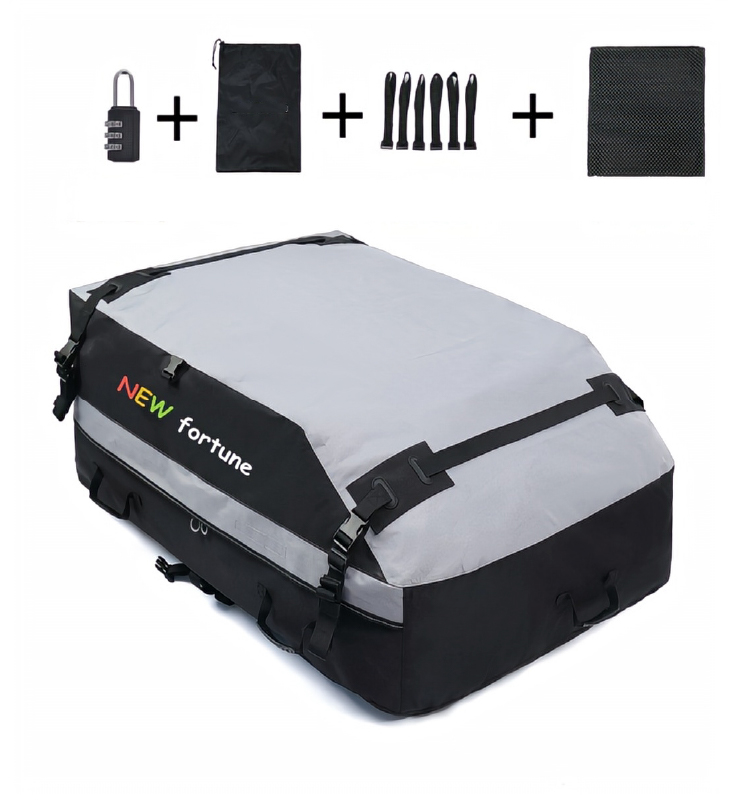 Wholesale Private Label FO-24 Waterproof Car Roof Top Bag 25 Cubic Foot Luggage New Fuda Luggages & Bags Co., Ltd is China Wholesale Private Label FO-24 Waterproof Car Roof Top Bag 25 Cubic Foot Luggage Carrier For Ou...View Product →
Mounting geometry also affects safety. Crossbar mounting is straightforward when the car has a rack. On cars without one, the door-frame straps must distribute force without damaging trim or paint. This is where cheap hardware fails: clips break, buckles slip, and the bag shifts forward under hard braking. The anti-slip mat and wide interior straps are the features that keep the load in place. Also check sunroof clearance and antenna position, and review the installation instructions before you approve printing, because those instructions become your customer service script after the goods are shipped.
Never rely on the word waterproof in a marketing spec. Agree on a measurable standard. The most practical contract test for a fabric shell is the hydrostatic head test: 1500 mm is entry level, and 3000 mm or more is the level we recommend for a product that will face rain on a highway. Zippers should be tested as an assembly with the bag, not as components, because water always finds the path of least resistance.
A simple factory-level check is a sustained spray test on a filled bag, followed by an interior inspection after thirty minutes. Run the same check on the pre-production sample and on the first articles of a batch. If the sample passes and the batch fails, the problem is usually in seam or zipper installation, which is exactly where inspection should be concentrated.
Before confirming a supplier, request the material specification with denier and coating weight, hydrostatic head test reports, zipper and webbing data, and a reference list of roof bag orders shipped in the last twelve months. A manufacturer with its own sewing lines and welding equipment can usually produce these documents in the first exchange; a trading company will need to ask its own factory and may not be able to answer process questions directly.
Wholesale roof bag prices leave almost no room for defect-driven returns. Agree on a sampling plan for the final inspection, define critical and major defects separately, and specify who pays for rework. A leaking seam or a broken zipper is a critical defect; a color deviation is major or minor. In a batch of five hundred pieces, one week of poor zipper installation can create a hundred customer complaints, so the inspection plan deserves as much attention as the unit price.
Logo printing, color matching, hang tags, and carton design all change the unit cost. Screen printing works for simple logos; heat transfer allows more colors. Packing folded bags in a polybag with a handle cutout can reduce carton volume by a third and improve your landed cost. Ask for loaded carton dimensions and gross weight so that freight quotes are realistic. A complete buyer's guide for car roof storage bags covers these commercial checkpoints in depth.
FOB price, freight, duty, warehouse space, and return handling belong in one calculation. Roof bags ship efficiently because they fold: a thousand units of a 15-cubic-foot bag occupy far less volume than the same value in hard boxes. But a slightly larger folded size can change the carton quantity per pallet, which is why the size and packaging decisions belong at the sourcing stage, not after the product is finalized.
The buyer who treats a roof top bag as a system, shell, seam, zipper, strap, mat, and instruction set, rather than as a single SKU, is the buyer who keeps the category profitable. New Fuda has manufactured soft luggage since 2006 and ships roof bag lines to Europe, the Americas, and Japan, with sewing and high-frequency welding under one roof. If you are planning a wholesale roof top bag program, request a quotation with your target volumes and specs from the factory contact page.
Your email address will not be published. Required fields are marked *
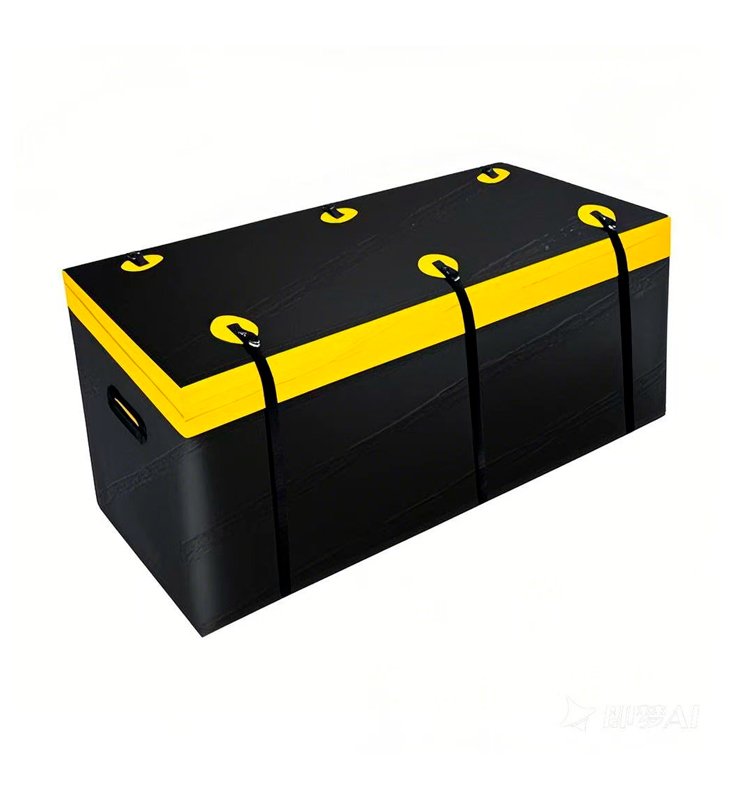

* Your email is safe with us, we don't spam.

Professional R & D and manufacturing of outdoor sports, cycling, fishing, business, travelling sewing, high-frequency stamping series of luggage enterprises
E-mail: christine@fudabags.com
Phone: +86-13819351116
Add: No.2288 Xinggong Road, Pinghu City, Jiaxing City, Zhejiang Province, China
Copyright © 2025 by New Fuda Luggages & Bags Co., Ltd. Rights Reserved. Privacy Custom Durable Outdoor Travel Bag Manufacturers


 English
 Français
 Español