


Get A Quote

Content
For offshore anglers, the preservation of a catch is a race against thermal degradation. A fish kill bag is not merely a storage pouch; it is a high-performance thermal barrier designed to maintain a stable internal environment. At New Fuda Luggages & Bags Co., Ltd., established in 2006, we have spent nearly two decades mastering the intersection of sewing and high-frequency production technologies. As a premier manufacturer of fish kill bag products, our engineering focus remains on the structural integrity of the container. This article examines the technical necessity of heavy-duty zippers for fish bags and heat-welded seams in kill bags, detailing how these components prevent brine leakage and maximize ice retention during extended maritime excursions.
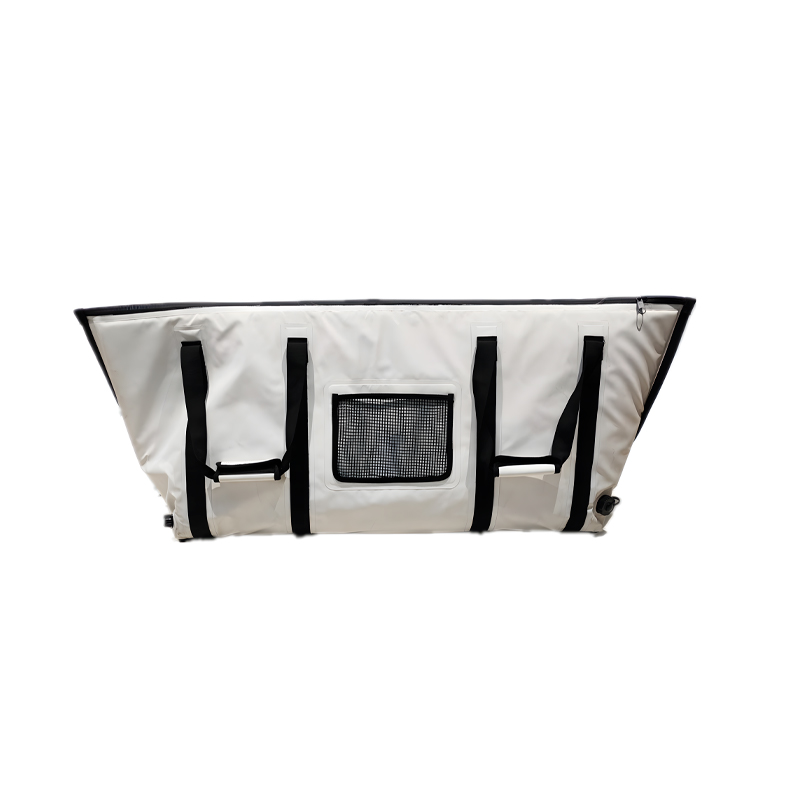
Traditional storage solutions often rely on stitched seams, which, regardless of thread strength, create thousands of micro-perforations in the fabric. In a fish kill bag, these holes become failure points for "brine seepage." Heat-welded seams in kill bags utilize high-frequency (HF) welding to fuse the inner and outer layers of TPU or heavy-duty PVC into a single, cohesive unit. When comparing heat-welded vs stitched fish bags, the welded version provides a molecular bond that is inherently airtight and watertight. This technology is vital for leak-proof fish bag technology, ensuring that bloody water and melted ice remain contained within the insulated cavity. For those seeking the best insulated fish kill bag for offshore fishing, the absence of needle holes is the primary indicator of professional-grade construction.
| Technical Feature | Stitched/Sewn Seams | Heat-Welded (High-Frequency) Seams |
| Leak Resistance | Prone to seepage at needle holes | 100% Hermetic seal |
| Tensile Strength | Dependent on thread quality | Homogeneous bond (Material-level strength) |
| Durability | Threads can rot or fray over time | Resistant to UV, salt, and abrasion |
The zipper is often the most stressed component of any luggage, particularly in heavy-duty insulated fish bags where ice weight and fish movement exert constant internal pressure. Utilizing heavy-duty zippers for fish bags, specifically oversized, corrosion-resistant resin or molded tooth zippers, is essential for operational reliability. These zippers are designed to prevent "seizing" in saltwater environments. What makes a fish kill bag durable is the addition of an airtight T-zip or a reinforced storm flap that works in tandem with the ice retention time in fish kill bags. Proper fish kill bag zipper maintenance, such as regular lubrication with silicone grease, ensures that the seal remains effective throughout the season.
| Zipper Type | Standard Nylon Coil | Heavy-Duty Molded/Waterproof Zipper |
| Thermal Retention | Low (Air leakage through teeth) | High (Airtight seal technology) |
| Saltwater Tolerance | Low (Metal sliders corrode) | High (Non-corrosive polymers) |
| Burst Strength | Moderate | Excellent (Designed for high-volume loads) |
A reliable fish kill bag is the sum of its parts. When high-frequency welding is combined with a large capacity fish kill bag for tuna, the result is a vessel capable of holding hundreds of pounds of weight without structural deformation. Beyond the seams and zippers, portable fish kill bag features like reinforced webbing handles and drain plugs are critical. Proper fish kill bag drainage and hygiene are facilitated by heat-welded drain ports that do not compromise the insulation. New Fuda Luggages & Bags Co., Ltd. applies these rigorous manufacturing standards to our pressing series, ensuring that whether you are using a foldable fish kill bag for easy storage or a rigid ice bucket bag, the catch remains fresh from the deck to the dock.
The reliability of a fish kill bag is fundamentally rooted in its ability to resist the harsh maritime environment. Through the implementation of heat-welded seams in kill bags and the integration of heavy-duty zippers for fish bags, New Fuda provides a product that exceeds the expectations of cross-border head sellers and global consumers. By prioritizing leak-proof fish bag technology and ice retention time in fish kill bags, we continue to serve as a preferred supplier for Europe, America, and Japan, upholding our reputation for excellence in outdoor sports and fishing luggage manufacturing.
Sewn seams involve needles puncturing the waterproof fabric, which eventually leads to leaking brine and blood. Heat-welded seams use high-frequency energy to melt the layers together, creating a permanent, 100% leak-proof bond.
Keep the bag closed as much as possible, use heavy-duty zippers for fish bags that are fully sealed, and ensure the bag has high-density closed-cell foam insulation. Pre-chilling the bag with a sacrificial bag of ice before adding the catch also helps.
Rinse with fresh water and mild soap immediately after use. Because of the leak-proof fish bag technology, you can fill it with water and a dash of bleach for a deep clean. Ensure the bag is completely dry before folding it for storage.
Yes. Many professional bags are designed as a foldable fish kill bag for easy storage. They provide massive volume when deployed but can be rolled up and secured with straps when empty, saving space on the boat.
Look for non-corrosive materials (plastics/TPU), UV-resistant outer shells, and zippers that do not have metal teeth. These features prevent the salt and sun from degrading the bag over several seasons.
Your email address will not be published. Required fields are marked *
* Your email is safe with us, we don't spam.

Professional R & D and manufacturing of outdoor sports, cycling, fishing, business, travelling sewing, high-frequency stamping series of luggage enterprises
E-mail: christine@fudabags.com
Phone: +86-13819351116
Add: No.2288 Xinggong Road, Pinghu City, Jiaxing City, Zhejiang Province, China
Copyright © 2025 by New Fuda Luggages & Bags Co., Ltd. Rights Reserved. Privacy Custom Durable Outdoor Travel Bag Manufacturers


 English
 Français
 Español