


Get A Quote

Content
When a brand team reviews the rooftop cargo category, one pattern repeats across sales channels: soft roof bags outsell hard-shell boxes in unit volume, generate faster inventory turns, and open a price point that converts first-time buyers. The reasons are practical. A roof bag folds flat into a storage pouch when the season ends, weighs a fraction of a hard shell, and adapts to a wider range of vehicles because it does not depend on precise rack geometry. For brands, the question is no longer whether to list a roof bag. It is how to build one that survives real road trips without creating returns, negative reviews, or warranty claims.
The conclusion first: soft roof bags are the most cost-effective route for a brand to enter or expand in the vehicle cargo category. A hard-shell box program requires significant tooling investment, bulky packaging, and dedicated warehouse space. A soft bag is a sewn or welded textile product that can be developed, sampled, and scaled with far less capital. That is why custom roof top bag solutions attract established outdoor brands and fast-growing cross-border sellers alike.
Consumers choose soft roof bags for three concrete reasons:
These three reasons create a retail niche that complements hard-box sales rather than cannibalizing them. Brands that understand this position the soft bag as the accessible choice for weekend road trips, while keeping hard boxes for premium, frequent-travel buyers.
The fabric choice determines the product's durability, weight, and cost. In custom roof top bag solutions, three materials appear most often in high-volume production.
| Material | Weight | Waterproofing | Best Fit For |
|---|---|---|---|
| 500D PVC-coated grid fabric | Heavy duty | Excellent | Multi-season road trips, harsh climates |
| Oxford fabric with PU coating | Mid weight | Good | Light to moderate use, easier folding |
| TPU laminated fabric | Light to mid | Excellent | Premium positioning, welded seams, PVC-free story |
For most volume programs, 500D PVC-coated grid fabric remains the workhorse. It resists abrasion from roof rails, sheds rain, and supports a packed load without stretching out of shape. If the target customer takes one or two long trips a year, Oxford with a PU coating delivers a lighter, softer-handling product at a lower cost point. If the product story is about premium materials, TPU laminates add the option of high-frequency welded construction and a cleaner environmental profile without PVC.
A practical example of this material logic is the 15 cubic foot 500D grid PVC carrier roof bag, the configuration many volume programs start with before adding custom colors and branding.
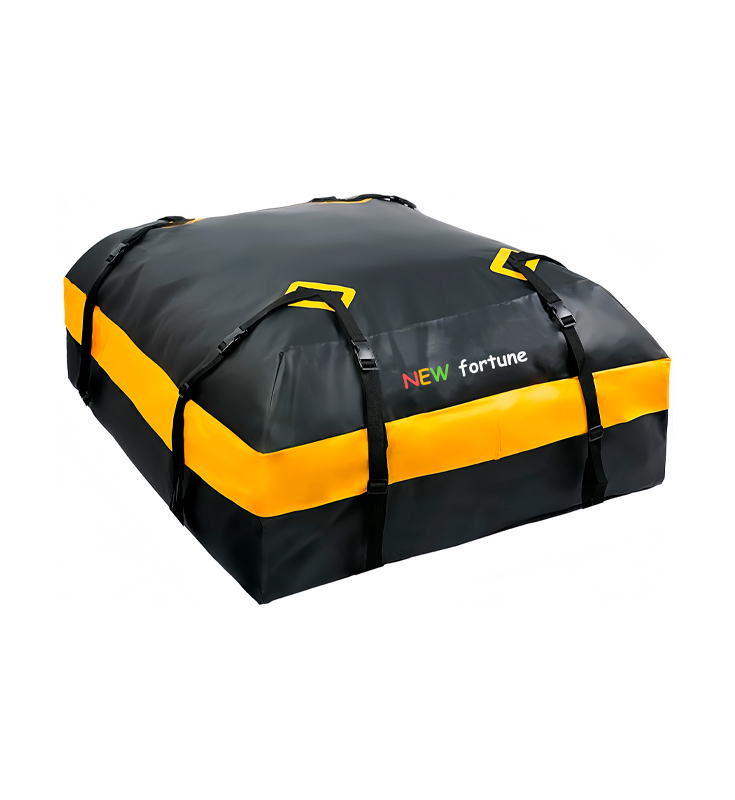 Wholesale Private Label FO-10 Waterproof 15 Cubic 500D Grid PVC Carrier Car RoofNew Fuda Luggages & Bags Co., Ltd is China Wholesale Private Label FO-10 Waterproof 15 Cubic 500D Grid PVC Carrier Car Roof Bag, SUV Roof...View Product →
One caution we share with every brand customer: do not let material selection be driven by price alone. A bag that splits at a seam after three uses will generate returns and negative reviews. Fabric grade, denier count, and coating thickness can look similar in a sample book but perform very differently over a two-year product lifecycle. For a closer look at how long-term outdoor performance is evaluated, the article on durability and performance of outdoor car roof luggage bags breaks down the important test points.
Construction technology decides whether a roof bag holds up in wet, windy, high-speed conditions. It is also where many brands discover that their supplier has only one capability. Our production background covers both sewn construction and high-frequency welding, which matters more than it first appears.
Sewn construction, with double-stitched seams and a coated or taped interior, is the standard for most roof bags. It allows complex shapes and keeps development costs low. High-frequency welding fuses PVC or TPU material at a molecular level, creating seams that are waterproof without tape. The same process is used for TPU coolers, water bladders, and inflatable products, so it brings a different standard of sealing to components such as floor panels and zip closures.
The practical implication for brands is simple: a supplier with both technologies can optimize every part of the bag. Reinforced straps can be sewn where tensile strength matters, while welded floor seams add waterproofing where moisture is most likely to intrude. This becomes important when you compare a waterproof roof bag vs a hard shell box, because soft bags need smart seam engineering to compensate for their flexible structure.
Brands that succeed with roof bags do not offer one size and stop. They build a range that fits different vehicle types and trip lengths. The most common capacities in the market fall between 11 and 25 cubic feet, with 15 and 19 cubic feet being the highest-velocity SKUs.
Shape matters more than volume. A 19 cubic foot bag with a rectangular footprint uses roof area more efficiently than a longer, narrower bag with the same capacity. We guide brand customers through these dimensions during development so the bag sits properly on compact SUVs and still leaves room for a full weekend load. For a practical staging point, the 19 cubic foot waterproof roof top bag is a configuration we recommend to brands entering the category, because it matches the majority of family vehicles and trip profiles.
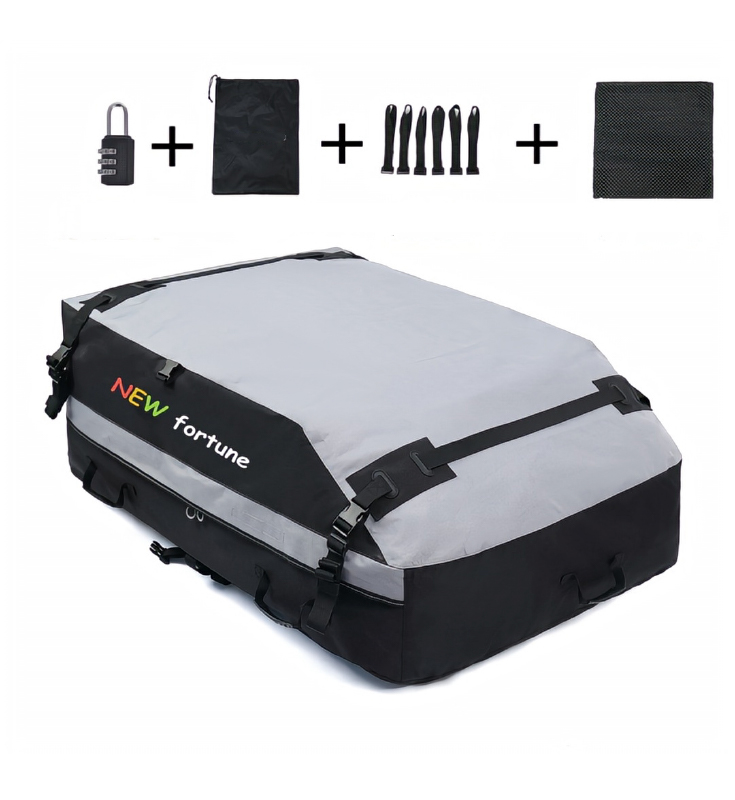 Wholesale Private Label FO-22 Jeep Roof Cargo Bag, Waterproof Car Roof Top Bag 1New Fuda Luggages & Bags Co., Ltd is China Wholesale Private Label FO-22 Jeep Roof Cargo Bag, Waterproof Car Roof Top Bag 19 Cubic Foot L...View Product →
Load capacity is a related decision that affects safety messaging. A 15 cubic foot bag rated for 110 to 150 pounds is realistic; a 25 cubic foot bag needs a stronger strap system and clearer warning labels. We advise brand customers to review the load capacity guidance for car roof storage bags before finalizing product copy and warranty terms.
The most common reason shoppers hesitate on a roof bag is fear, not price. They worry about wind noise, scratches on the roof, or the bag releasing at highway speed. A well-engineered mounting system is the direct answer to all three concerns.
The mounting package should include:
We treat the mounting system as a core component, not an afterthought. The large capacity waterproof roof bag with anti-slip mat demonstrates this approach, because the mat is integrated into the base of the bag and the user does not need to align a separate accessory during installation.
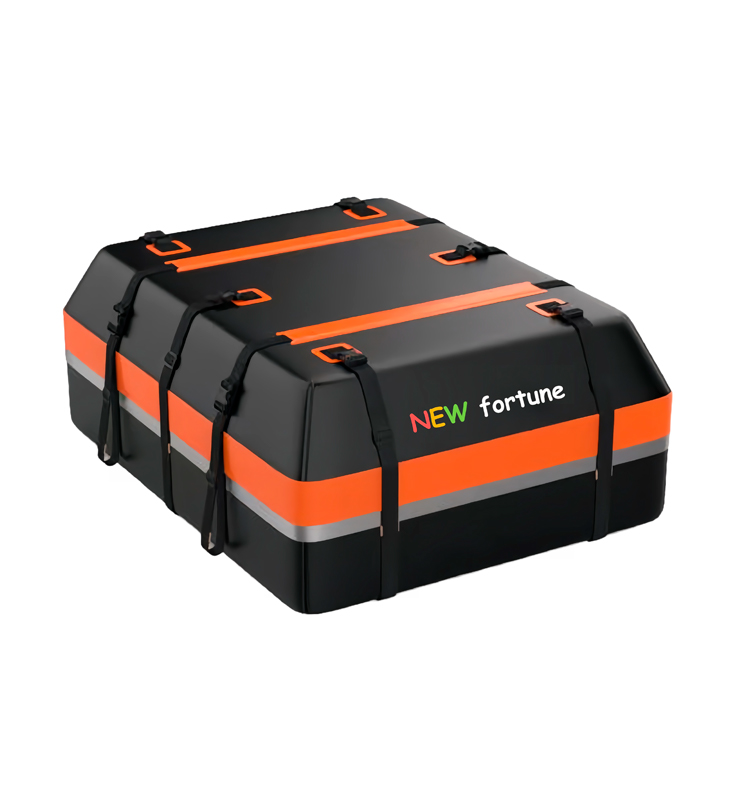 Wholesale Private Label FO-14 Large Capacity Universal Waterproof Car Roof CargoNew Fuda Luggages & Bags Co., Ltd is China Wholesale Private Label FO-14 Large Capacity Universal Waterproof Car Roof Cargo Luggage Carri...View Product →
Custom roof top bag solutions should not stop at a logo print. Brands that build the strongest positions use customization across the entire product expression:
Every customization should be evaluated against your target retail price. A heavier fabric, a better zipper, or a welded floor seam adds a small cost per unit, but each feature can justify a higher price point when communicated clearly in the product listing.
The difference between a commodity roof bag and a successful brand program usually comes down to the supplier's development process and production discipline. Here is what to check before placing a volume order.
A partner that can produce a first-article sample with correct seam allowance, strap routing, and the exact material finish you specified is rare. Confirm how many sample rounds are included, how pattern changes are handled, and whether the pre-production sample uses the same material rolls as the final production run. This prevents the classic surprise of an approved sample that does not match the shipped goods.
Roof bags involve both sewing and, in some configurations, high-frequency welding. Verify that both capabilities exist in the same factory. If welding is outsourced, quality consistency and delivery control suffer. Ask about capacity planning as well: can the plant run your volume alongside other orders without delaying your shipment window? A direct relationship with a production-led manufacturer gives you clearer visibility into lead times, defect rates, and corrective actions than a trading company can offer.
Look for a factory that performs simple but meaningful checks: strap pull tests, seam tension tests, waterproof validation on coated materials, and carton drop tests when packed. These checks do not have to be expensive, but they must exist as a routine rather than a favor. A supplier that treats quality as a shared responsibility helps you reduce returns before they reach your customers.
Custom roof top bag solutions for brands are not about changing a zipper color and calling it a design. They are about deliberate decisions in material grade, construction technology, capacity planning, mounting engineering, and quality control, executed consistently across every unit. Brands that work with a manufacturing partner that understands both sewing and welding, and that treats product development as a collaborative process, enter the rooftop cargo category with a meaningful advantage: a product that performs, a supply chain that responds, and a brand experience that earns repeat purchases.
Your email address will not be published. Required fields are marked *

* Your email is safe with us, we don't spam.

Professional R & D and manufacturing of outdoor sports, cycling, fishing, business, travelling sewing, high-frequency stamping series of luggage enterprises
E-mail: christine@fudabags.com
Phone: +86-13819351116
Add: No.2288 Xinggong Road, Pinghu City, Jiaxing City, Zhejiang Province, China
Copyright © 2025 by New Fuda Luggages & Bags Co., Ltd. Rights Reserved. Privacy Custom Durable Outdoor Travel Bag Manufacturers


 English
 Français
 Español