


Get A Quote

Content
Every season, importers write off batches of car top carrier bags because the production specification was vague. A typical case: a buyer orders 5,000 units through a trading agent, specifies "waterproof roof bag" as the entire requirement, and receives bags with 300D polyester bodies instead of the specified 500D PVC-coated fabric, stitched-only seams that weep under highway rain, and zippers that fail after 300 open-close cycles. The defect is not discovered until the container reaches the fulfillment center.
Car top carrier bags are engineered soft goods, not generic duffels. An OEM buyer who cannot define fabric denier, seam construction, zipper water resistance, payload, and anti-slip behavior leaves every decision to the production floor. Load capacity and fabric choice must be locked before sampling, because every downstream decision follows from those two inputs.
Seven locked specification points prevent most car top carrier bag defects before cutting begins. Unwritten requirements cause more OEM failures than stitching skill ever will.
A car top carrier bag is a soft, rack-mountable cargo container designed to sit on a vehicle roof and carry luggage, camping gear, or sporting equipment without a hard-shell box. For OEM purposes, the definition must go further: it is a fully specified soft goods assembly with verified material grades, sealed seams, tested zippers, and a documented load-to-fixation relationship with the vehicle rack.
A production-ready car top carrier bag specification includes the target volume in cubic feet, the maximum static and dynamic load, the fabric construction with denier and coating, the seam sealing method, the zipper system's waterproof rating, the anti-slip mat material, and the strap attachment geometry.
Buyers should prepare these seven points before contacting a factory:
The bill of materials is the most important specification sheet in a car top carrier bag OEM project. Roof bags face UV exposure, highway wind load, rain, vibration, and repeated fold-pack cycles; a fabric that works for a trunk organizer will delaminate within one season on a roof.
| Material | Construction | Water resistance | Best fit |
| 500D PVC-coated polyester | Woven base with PVC film | High, with taped seams | Heavy-duty long-trip carriers |
| 300D Oxford polyester | Tight weave with PU backing | Moderate, needs rain cover | Light urban and weekend use |
| TPU film laminate | Textile bonded to TPU layer | Fully sealed by RF welding | Premium waterproof cargo bags |
| PVC tarpaulin mesh | Laminated woven mesh | Very high | Commercial and fleet use |
For most European and US retail programs, 500D PVC-coated polyester with high-frequency welded seams is the mainstream configuration because it balances abrasion resistance, waterproof behavior, and production cost. A TPU laminate with radio-frequency welding becomes the differentiator for premium positioning.
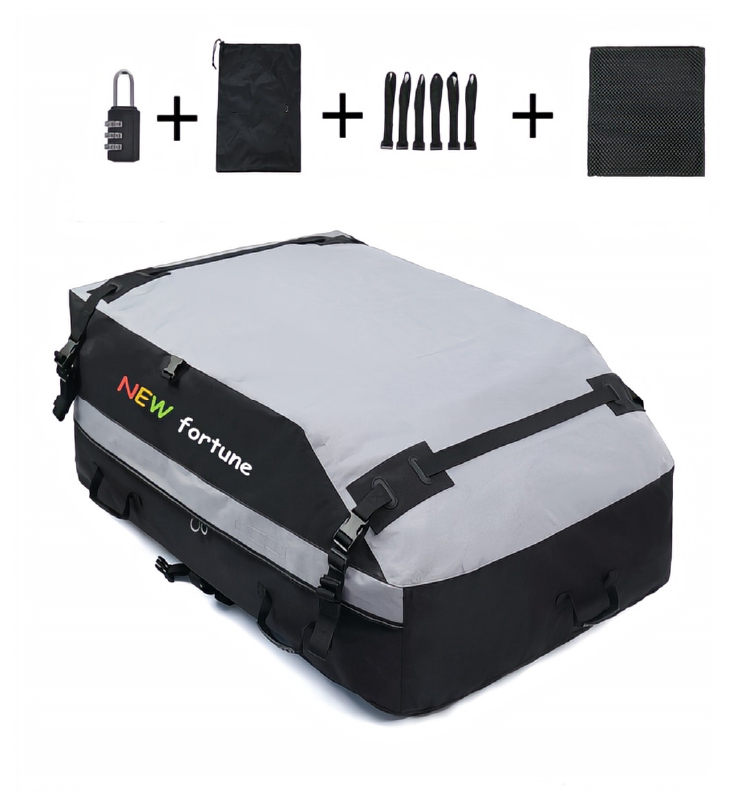
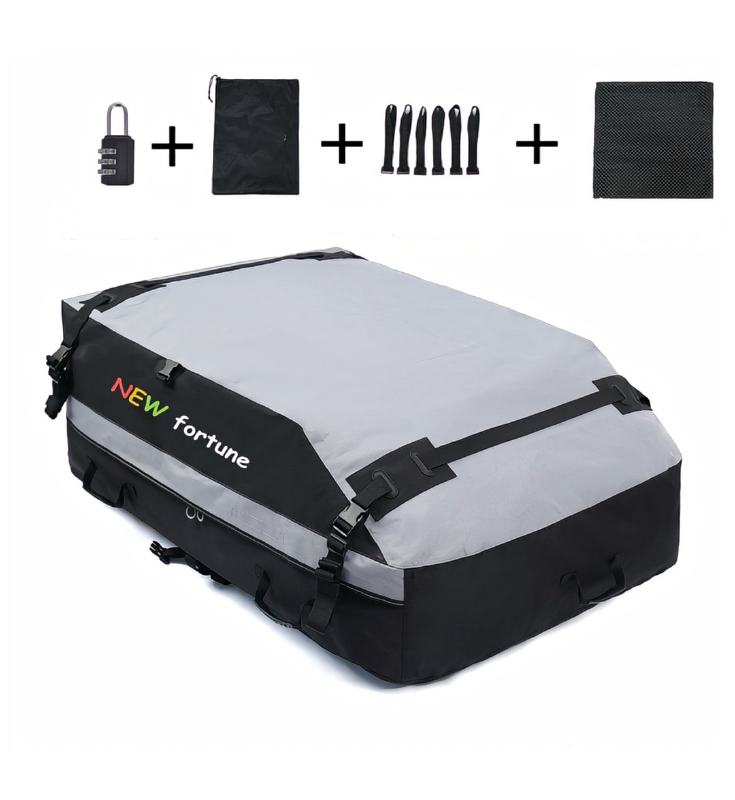
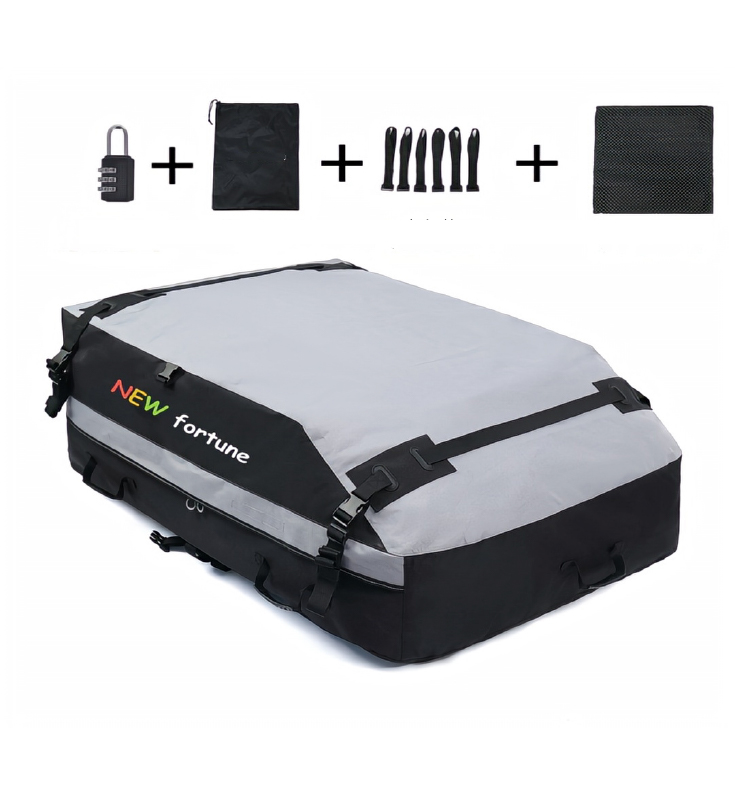
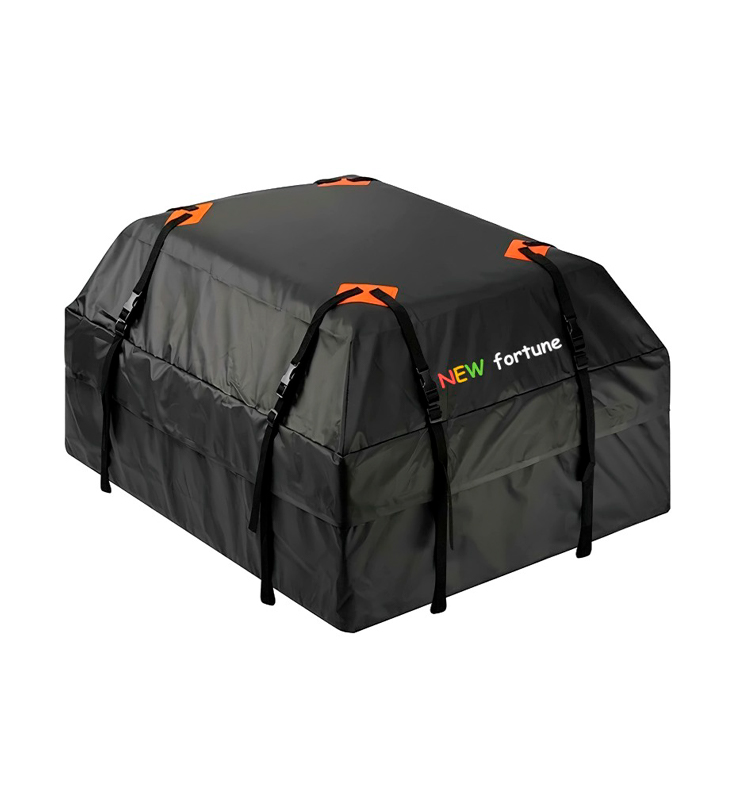 FO-2 Heavy Duty Waterproof Rooftop Cargo Bag with 15 Cubic Feet CapacityThis 500D PVC-coated roof bag offers 15 cubic feet of weatherproof storage with heat-sealed seams, door hooks, protective pads, and a lock. Its lightweight 2.1kg build makes it a practical choice for retail programs needing balanced durability and cost.View Product →
OEM customization goes far beyond logo printing. Every change below shifts the cutting plan, the seam sequence, or the hardware inventory, so it changes both unit cost and delivery window.
Payload values assume a roof rail rated for at least 75 kg dynamic load; always verify against the vehicle manual.
For a retail program aimed at families and long-distance drivers, a mid-size unit balances footprint, usable volume, and payload.
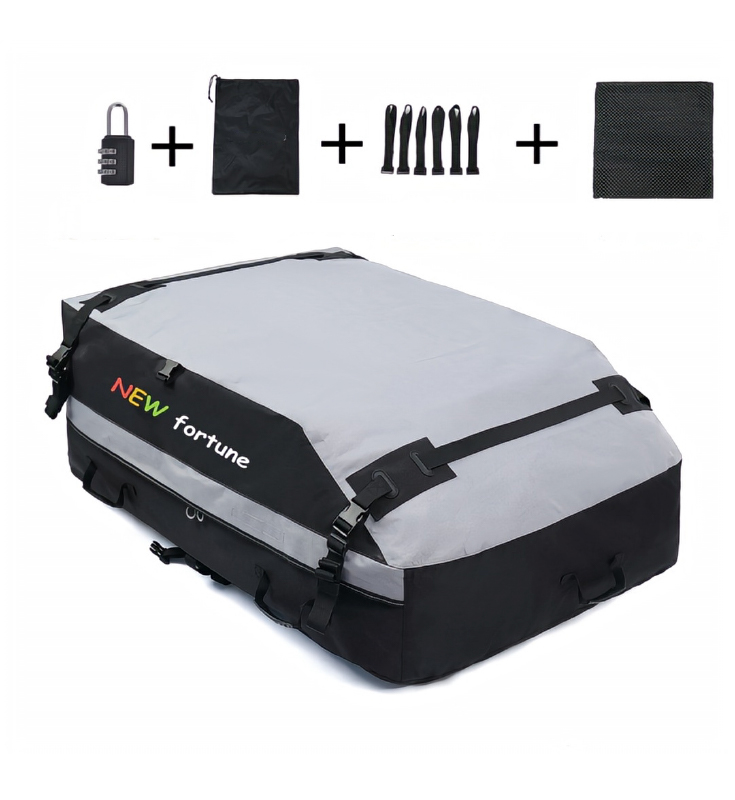 FO-22 19 Cubic Foot Waterproof Jeep Roof Top Cargo BagA high-capacity Oxford cloth roof bag with 19 cubic feet of space, heat-welded seams, and integrated tie-downs. Designed for vehicles without permanent racks, it suits family trips and gear-heavy outdoor adventures while maintaining an aerodynamic profile.View Product →
An OEM order for a car top carrier bag moves through five production stages regardless of whether the main body is sewn or high-frequency welded. New Fuda Luggages & Bags Co., Ltd. operates both sewing lines and radio-frequency welding stations, which lets one factory handle fabric bodies, welded PVC and TPU constructions, and mixed assemblies without subcontracting.
The factory checks target volume, vehicle fit, and material assumptions against its cutting and welding capacity. Pattern drafts are prepared with dimensional tolerances of plus or minus 1 cm on the main body.
A first article is sewn or welded, loaded with sandbags to verify payload, and sprayed with water to check seam behavior. Sample lead time for a roof bag is 7 to 15 days.
Fabric rolls are tested for coating adhesion, denier consistency, and color difference against the approved standard. Zippers, webbing, anti-slip mats, and buckles are batch-checked before cutting.
Die cutting creates nested panels to minimize waste; sewing lines assemble the body; radio-frequency welding presses seal PVC or TPU seams. In-line QC verifies weld integrity at defined intervals.
Every unit receives a seam pull test, zipper cycle test, and visual inspection. Packed bags are compressed to agreed dimensions and cartons are drop-tested before loading.
For orders that include the anti-slip mat and safety-lock strap system, the factory verifies the fixation geometry against a standard roof rack fixture.
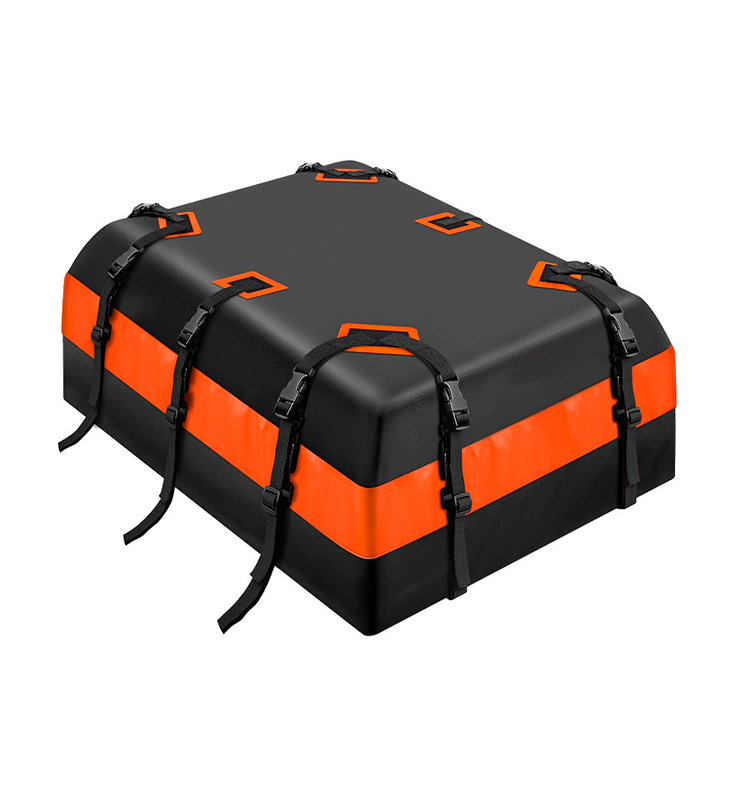 FO-1 Soft Waterproof Rooftop Cargo Bag with 21 Cubic Feet and Safety LockThis soft-shell roof bag provides 21 cubic feet of storage from 500D grid PVC with heat-sealed seams. Its universal strap and door hook fitment, protective pads, and integrated lock make it a versatile option for sedans, SUVs, and vans.View Product →
Quality control for car top carrier bags is a measurable, testable process, not a promise written into a quotation. A capable factory schedules specific test points and documents the results for every batch.
A 5 cm seam section must resist a defined pull force, usually 30 kg or higher for welded PVC and TPU constructions, without separation.
An assembled bag is sprayed from multiple angles for 15 minutes; interior moisture is checked against the agreed standard.
Main compartment zippers are opened and closed 500 to 1,000 cycles under load to expose weak sliders and poor tape attachment.
The loaded bag is strapped onto a rack fixture and run on a vibration bench to confirm the straps hold position without edge chafing.
If a supplier cannot name a test method and a numeric pass/fail limit for at least these four points, treat the quotation as incomplete. Test limits and the factory's actual pass rate belong inside the OEM agreement before mass production, not after the first container arrives.
OEM buyers should evaluate supplier capability around four criteria: manufacturing process coverage, sample responsiveness, MOQ structure, and documentation discipline. A factory that owns both sewing and high-frequency welding capacity can produce a welded main body with stitched accessory pockets without routing work to subcontractors.
| Criterion | What to verify | Warning sign |
| Process coverage | In-house sewing lines and RF welding stations | Subcontractor-dependent assembly |
| Sampling speed | First sample in 7 to 15 days with test report | No sample capacity before order confirmation |
| MOQ structure | 300 to 500 units per color, mixed sizes allowed | Push for 5,000 units before any sample |
| Test documentation | Water spray, seam pull, zipper cycle reports | References to quality without test data |
For a deeper breakdown of sizing, waterproofing, and mounting trade-offs, the complete buyer's guide to car roof storage bags lists the decision criteria used by importers and brand teams.
Visit the factory during the sampling phase, not after the purchase order is signed. Watch whether the QC station actually logs test numbers and whether the welding operator can explain the temperature and pressure settings for the fabric you chose.
Most OEM factories work from a starting MOQ of 300 to 500 units per color, with mixed sizes accepted in the same batch. Lower MOQs are possible for stock designs with existing tooling, while fully custom patterns usually trigger the higher threshold.
Write an explicit water-column rating, with 3,000 mm as the minimum for coated fabrics, or require an IPX4-equivalent spray test on the fully assembled bag. Welded PVC and TPU constructions pass this level consistently; stitched-only seams need seam tape or they will leak under highway rain.
Use 500D PVC-coated polyester for a mid-priced, abrasion-resistant line that performs in rain and long-distance use. Choose TPU laminate with high-frequency welding for a premium, fully sealed bag that folds more compactly and avoids the plasticizer odor of PVC. TPU raises unit cost and requires a factory with RF welding capability.
A first article sample for a car top carrier bag typically takes 7 to 15 days after specification approval, including pattern drafting, sewing, welding if applicable, and a basic water spray check. First batch production lead time is usually 30 to 45 days depending on fabric procurement and factory load.
Send a draft specification sheet rather than a product photo when requesting a quote. Factories respond with more accurate pricing and sampling timelines when they can read target volume, fabric, mounting type, and a price band.
Your email address will not be published. Required fields are marked *

* Your email is safe with us, we don't spam.

Professional R & D and manufacturing of outdoor sports, cycling, fishing, business, travelling sewing, high-frequency stamping series of luggage enterprises
E-mail: christine@fudabags.com
Phone: +86-13819351116
Add: No.2288 Xinggong Road, Pinghu City, Jiaxing City, Zhejiang Province, China
Copyright © 2025 by New Fuda Luggages & Bags Co., Ltd. Rights Reserved. Privacy Custom Durable Outdoor Travel Bag Manufacturers


 English
 Français
 Español