


Get A Quote

Content
A 20-litre TPU portable soft cooler weighs about 1.6 kg empty and holds ice for 24 to 36 hours at 25 C ambient. A rotomolded hard cooler of the same internal volume weighs around 5.8 kg. That four-kilogram gap explains why welded TPU bags now ride on kayak decks, in bicycle panniers and on car back seats, and it is the reason the seam specification, not the logo, decides whether the bag is still usable after a full season.
Camping stresses pack-down volume. Fishing stresses the liner and the closure. Travel stresses fold-flat geometry and security screening. A specification that satisfies all four at once is usually over-built and over-priced, so the practical task is to pick the two that matter and build the bag around them.
A TPU portable soft cooler is an insulated soft-sided bag whose inner liner, or liner plus outer shell, is made from thermoplastic polyurethane joined by high-frequency welding instead of stitching. Radio-frequency energy at 27.12 MHz heats the polymer at the seam interface until the two surfaces fuse into one continuous film.
The seam is the product. A stitched cooler liner has hundreds of needle holes; a welded TPU liner has none.
Material grades matter as much as the process. Food-contact TPU liners are specified against FDA 21 CFR 177.2600 in the United States and EU Regulation 10/2011 in Europe. Watertightness of a finished bag is quoted against IEC 60529, where IPX7 means 30 minutes of immersion at 1 metre. TPU film for a load-bearing cooler body normally runs between 0.5 mm and 0.8 mm.
| Material | Joining process | Cold flexibility | Plasticiser | Positioning |
| TPU | High-frequency welding at 27.12 MHz | Flexible to about -30 C | None added | Premium coolers, fishing and marine |
| PVC | HF welding with plasticiser in the compound | Stiffens below 0 C | Phthalate class | Entry-level coolers |
| PEVA | Heat sealing only | Moderate | None | Lunch bags and picnic totes |
TPU also avoids the plasticiser migration seen in older PVC bags. No phthalate leaves the film, so the liner does not turn tacky or crack after repeated heat cycles in a parked car, which is one of the first things to fail on a budget cooler.
High-frequency welded TPU addresses the three failure modes that end a soft cooler's working life early: seam leakage, abrasion along the fold lines, and UV embrittlement of the outer shell.
The closure is the second failure point. A waterproof zipper preserves the IPX7 claim at higher cost; a roll-top with a welded buckle is cheaper, lighter and slower to open. Fishing programmes should specify the zipper. Beach and picnic programmes rarely need it.
For camping, a TPU soft cooler wins on pack-down volume rather than absolute ice retention: an empty 30-litre soft cooler folds to roughly a third of its loaded height, which decides whether it travels in a car, a canoe or a two-person tent.
The chart below uses the condition most manufacturers quote: a 2:1 ice-to-content ratio by weight at 25 C ambient, with the bag kept out of direct sun. Ambient temperature moves these numbers more than capacity or wall thickness does.
Overlanding adds a second requirement: the cooler has to coexist with the rest of the vehicle load. A fold-flat bag that packs into the same footprint as a trunk storage bag is easier to live with than a rigid box that must be lifted out before every grocery run. For walk-in campsites, a backpack format keeps both hands free and spreads 10 kg of ice and food across the shoulders instead of one hand.
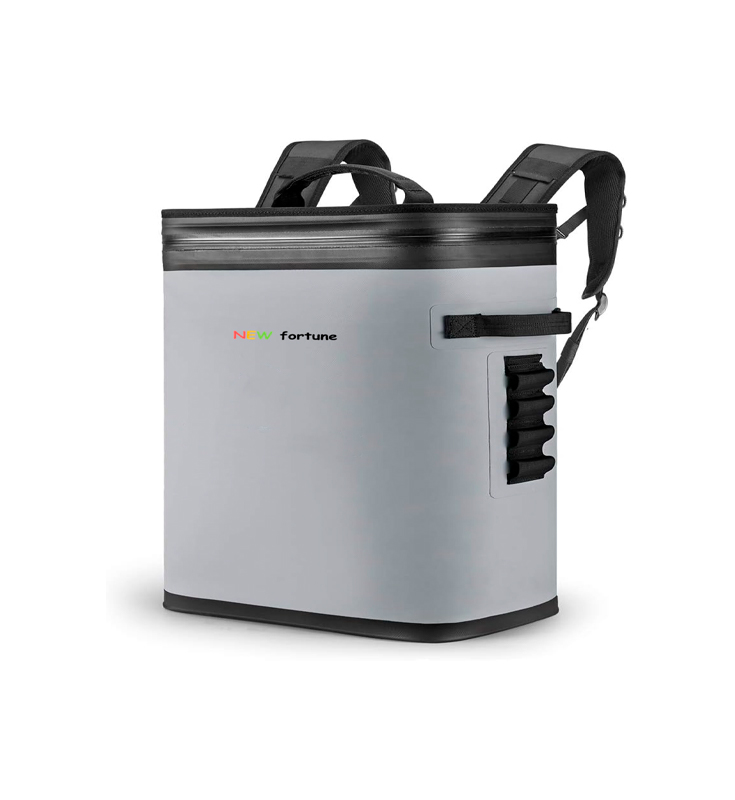 F-004 Backpack-Style TPU Soft Cooler BagA backpack-style TPU cooler with EPE/EVA insulation and customizable logo, suited to walk-in campsites and fishing trips where hands-free carrying matters.View Product →
On a fishing trip a soft cooler does two jobs at once: it keeps food and drinks cold and it holds the catch at a temperature that protects eating quality. A welded TPU liner complying with FDA 21 CFR 177.2600 can do both without a separate fish bag.
Insulated catch storage only works if the liner can be cleaned back to food-contact condition after every trip. That is a materials question before it is a marketing one.
Ice retention figures are only comparable when ambient temperature, load and ice ratio are stated, and a published U-value and cold retention test method makes those numbers checkable rather than promotional.
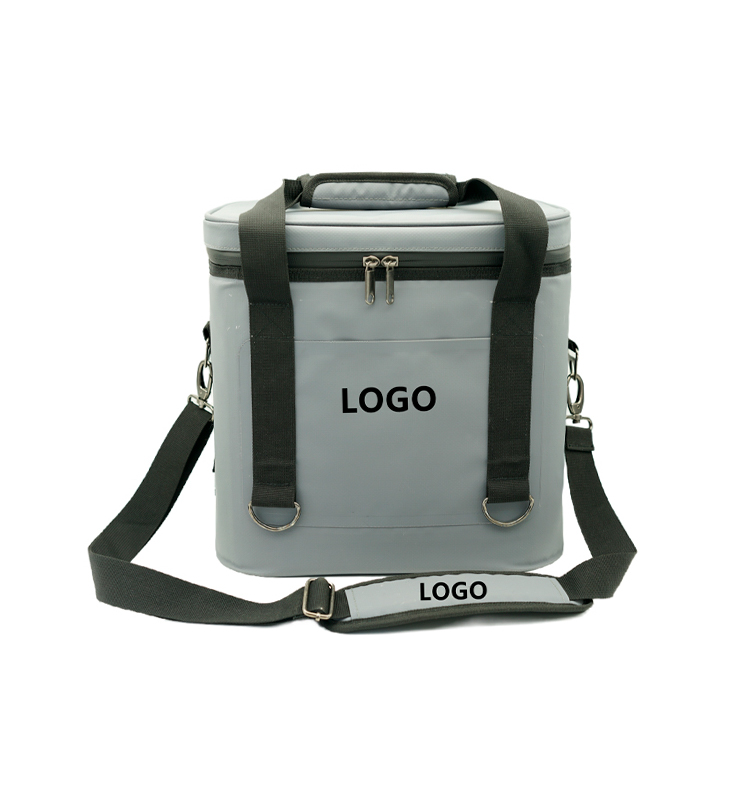 F-001 Shoulder-Style TPU Soft Pack CoolerA shoulder-style TPU cooler with EPE/EVA insulation and double waterproof zippers, plus a tested 35°C, 48-hour ice retention result for inshore trips.View Product →
A 20-litre shoulder format is what most inshore anglers end up carrying. The 40-litre class suits boat decks where the bag stays upright for the whole session.
For travel the binding constraint is geometry rather than ice time: a 20-litre TPU soft cooler that folds to about 8 cm flat fits inside a carry-on, while an equivalent hard cooler occupies the same space empty as it does full.
Security screening treats frozen ice packs as solids. Once a gel pack has partly melted, most airports apply the 100 ml liquid rule to the contents, so the practical rule is to freeze solid before departure and expect a secondary check if the surface looks wet.
For road trips the model that matters is the one with a waterproof zipper. A bag riding in an open truck bed or on a roof rack meets rain, spray and dust, and the zipper is the part that fails first.
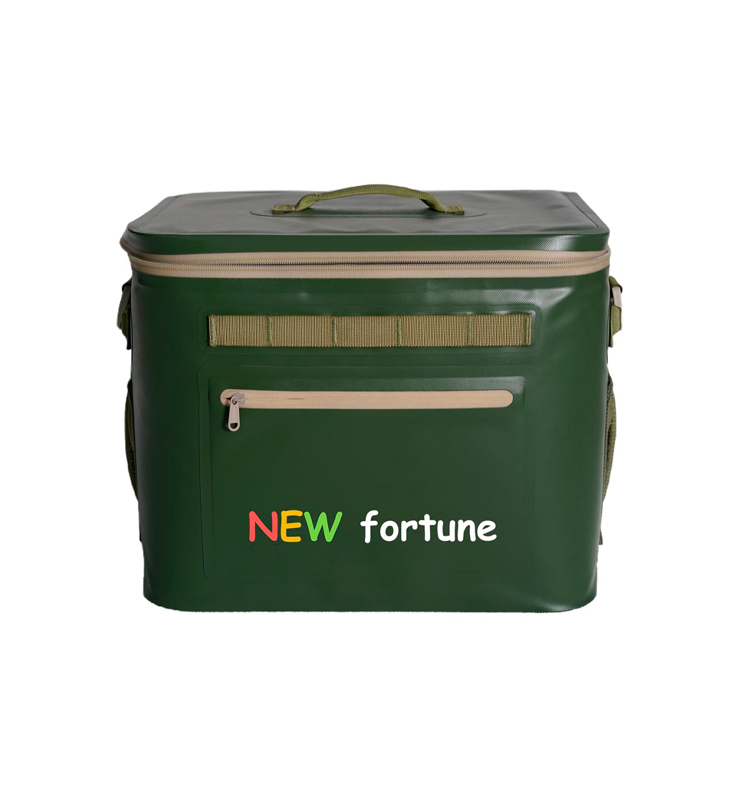 F-025 Foldable Soft Cooler with Waterproof ZipperA large-capacity foldable TPU cooler with waterproof zipper and EPE/EVA insulation, suited to road trips, outdoor parties and exposed vehicle loads.View Product →
Matching format to application is a four-column decision: capacity follows trip length, closure follows exposure, and wall thickness follows how long the bag has to hold ice.
| Application | Format | Capacity | Closure | Insulation |
| Day hike, picnic | Tote or shoulder bag | 8-15 L | Roll-top | 15-20 mm PE foam |
| Weekend camping | Backpack | 20-30 L | Waterproof zipper | 25-30 mm PE foam |
| Inshore fishing | Shoulder bag, welded liner | 20-40 L | Waterproof zipper | 25-30 mm PE foam |
| Travel, road trip | Fold-flat backpack or tote | 15-25 L | Roll-top | 20 mm PE foam |
| Beach day | Tote | 10-20 L | Roll-top | 15 mm PE foam |
Wall thickness is the trade: every step up in foam buys retention and costs weight, and weight is the reason a soft cooler was chosen in the first place.
Pre-chilling the empty bag and loading at a 2:1 ice-to-content ratio by weight are the two largest levers on ice retention, and skipping the pre-chill is the most common reason a bag underperforms its quoted figure.
Three specifications drive most of the unit cost of a TPU soft cooler: film thickness, closure type, and whether the seams are welded or stitched.
New Fuda Luggages & Bags Co., Ltd., a Pinghu-based manufacturer founded in 2006, runs both sewing and high-frequency welding lines and states that its welded series has become a preferred supply line for top cross-border sellers. Products ship to Europe, the Americas and Japan, and orders run through a B2B quote process rather than retail.
Welding parameters, film grades and minimum order logic are set out in the TPU cooler bag wholesale specification guide.
At 25 C ambient with a 2:1 ice-to-content ratio by weight, a welded TPU soft cooler in the 20 to 30 litre class holds ice for 24 to 36 hours. Ambient temperature is the dominant variable, and retention measured at 25 C does not carry over to a 35 C vehicle interior, so a bag that lives in a hot car needs 25 to 30 mm foam rather than 15 mm.
For welded, food-contact and cold-weather use, yes. TPU welds at 27.12 MHz with no plasticiser in the compound, stays flexible to about -30 C, and can be specified to FDA 21 CFR 177.2600 and EU Regulation 10/2011. PVC needs plasticiser, stiffens below 0 C and raises a phthalate question on food-contact grades.
For inshore, kayak and jetty fishing, a 20 to 40 litre welded soft cooler works and takes up deck space a hard box cannot. For offshore trips carrying 20 kg of ice and a multi-day catch volume, a hard box still holds ice longer and drains more easily at the dock.
Yes. Frozen ice packs pass screening as solids, while partly melted gel packs fall under the 100 ml liquid rule in most jurisdictions. A fold-flat 20 litre TPU bag that packs down to about 8 cm takes almost no space inside a checked bag.
TPU portable soft coolers support outdoor, camping, fishing and travel applications because a welded seam removes the leak path, the TPU film removes the plasticiser problem, and the soft body removes the four kilograms of dead weight a hard cooler carries. Pick the format from the trip, specify the closure from the exposure, and set the foam thickness from the ambient temperature the bag will actually sit in.
Your email address will not be published. Required fields are marked *
* Your email is safe with us, we don't spam.

Professional R & D and manufacturing of outdoor sports, cycling, fishing, business, travelling sewing, high-frequency stamping series of luggage enterprises
E-mail: christine@fudabags.com
Phone: +86-13819351116
Add: No.2288 Xinggong Road, Pinghu City, Jiaxing City, Zhejiang Province, China
Copyright © 2025 by New Fuda Luggages & Bags Co., Ltd. Rights Reserved. Privacy Custom Durable Outdoor Travel Bag Manufacturers


 English
 Français
 Español