


Get A Quote

Content
A 19 cubic foot roof bag adds roughly 538 liters of cargo space to a mid-size SUV, close to the volume of the whole rear load bay with the seats up. It also spends part of a budget few buyers ever check: the vehicle's dynamic roof load rating, typically 50 kg (110 lb) on passenger cars and 75 to 100 kg (165 to 220 lb) on crossovers, SUVs and wagons. The bag itself, the crossbars and the anti-slip mat all count toward that figure before the first duffel goes in.
Choosing the right car roof bag for long-distance travel and outdoor activities comes down to three decisions taken in order: the dynamic load your vehicle can legally carry, the capacity in cubic feet that matches your passengers and trip length, and the fabric and seam construction that decides whether gear arrives dry after a full day of highway rain.
This guide follows that order and then flags the specification points that matter when the same bag has to be bought by the hundred for resale rather than one at a time.
A 50 kg (110 lb) dynamic roof limit minus a 4 kg bag and 5 kg of crossbars leaves 41 kg (90 lb) of usable cargo, about the weight of two full 20 liter water containers.
Your ceiling is the vehicle's dynamic roof load rating, not the bag's advertised capacity. That rating sits at about 50 kg (110 lb) for many passenger cars, 75 kg (165 lb) for crossovers and 100 kg (220 lb) for full-size SUVs and wagons, and it is assessed under the ISO 11154 roof load carrier test framework for driving conditions.
The figure is published in the owner's manual under roof load or roof rack capacity, and it is dynamic: it applies while the car is moving, at speed, over expansion joints and potholes. Static ratings are a separate matter. A roof platform rated to 300 kg when parked is not permission to drive with 300 kg overhead.
Once the empty hardware is subtracted, the cargo budget is smaller than most buyers expect. The table below runs the arithmetic for three common vehicle classes.
| Vehicle class | Dynamic roof limit | Empty bag and straps | Crossbars | Cargo budget |
| Passenger car | 50 kg (110 lb) | 4 kg (9 lb) | 5 kg (11 lb) | 41 kg (90 lb) |
| Crossover | 75 kg (165 lb) | 5 kg (11 lb) | 6 kg (13 lb) | 64 kg (141 lb) |
| Full-size SUV | 100 kg (220 lb) | 5 kg (11 lb) | 8 kg (18 lb) | 87 kg (192 lb) |
Dense cargo reaches those figures quickly. Twenty liters of water weighs 20 kg, so two full containers consume half of a passenger car's roof budget. Textiles behave very differently: a 15 cubic foot bag packed with clothing and sleeping bags typically lands between 25 kg and 30 kg. Roof bags suit bulky loads, not tools, tinned food or drinks. Buyers who need to compare loading rules across vehicle types can check the practical roof bag load capacity breakdown before ordering.
A 15 cubic foot (425 L) roof bag covers roughly one week of travel for two or three people, while a 19 to 20 cubic foot (538 to 566 L) bag is the practical size for a family of four on a two-week drive.
Plan on packing about 85 percent of the stated volume. Rounded corners, the roll-top or zipper closure and the seam allowance all consume space, so a 20 cubic foot bag realistically swallows around 17 cubic feet of duffels. Soft bags compress as well: a half-full 25 cubic foot bag folds down to the height of its contents, which removes the main argument for buying small.
Packed volume by roof bag size (1 cubic foot = 28.32 L)
Sizing is also a weight decision. A larger bag invites more cargo, and every kilogram above the dynamic roof limit transfers into the roof panel, the rails and the crossbars. Step up a size only when the load is bulky rather than dense. For the family-of-four case, a 19 cubic foot class bag with a welded seam body and four to six anchor points holds a week of soft luggage without pushing a crossover past 64 kg of usable roof cargo.
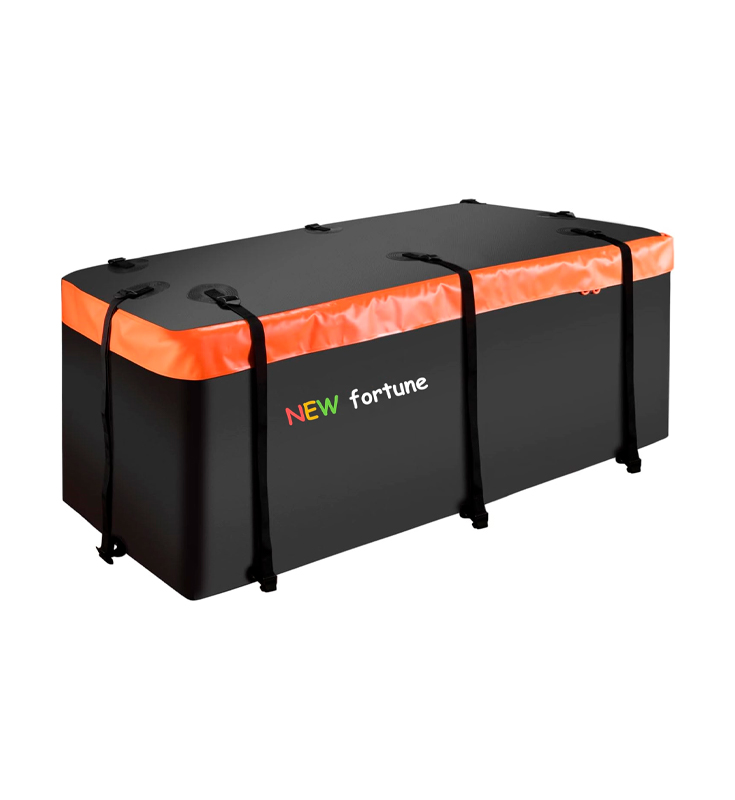
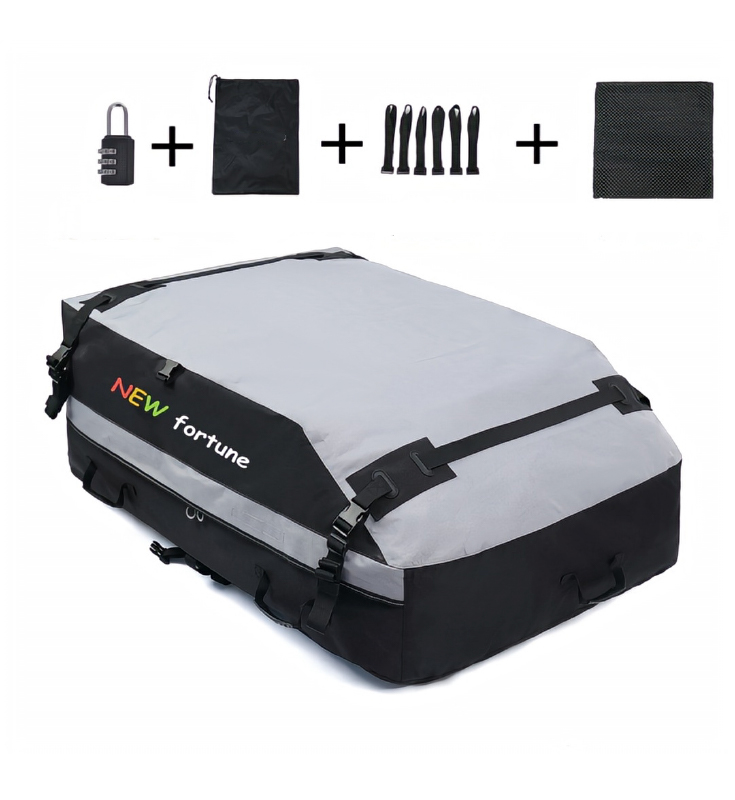 FO-22 19 Cubic Foot Waterproof Roof Cargo BagA 19-cubic-foot soft roof bag for bulky family luggage, with heat-welded seams, a covered zipper and mounting for vehicles with or without roof racks.View Product →
Gear stays dry when the fabric carries a hydrostatic head of at least 5,000 mm measured under ISO 811 and the seams are welded or taped rather than stitched, with a covered waterproof zipper as the closure.
Denier describes yarn weight, not waterproofing. A 500D polyester oxford and a 600D weave both need a coating to shed water, and the practical options are PVC coating, PU coating or a laminated TPU film. Welded construction matters more than the number on the label: high-frequency welding fuses TPU or PVC layers using radio frequency energy, typically at 27.12 MHz, with a 20 to 25 mm overlap, producing a joint with no needle holes. A stitched seam punches hundreds of holes straight through the coating, and water follows them.
UV exposure is the other long-term failure mode. Xenon-arc testing to ISO 4892-2 is the accepted method for screening coatings against colour and strength loss, and a bag left on a roof rack for an entire summer absorbs far more UV than one removed after each trip. A 500D grid PVC carrier bag built to 15 cubic feet sits at the midpoint of the volume and cost range and remains the most requested specification from importers.
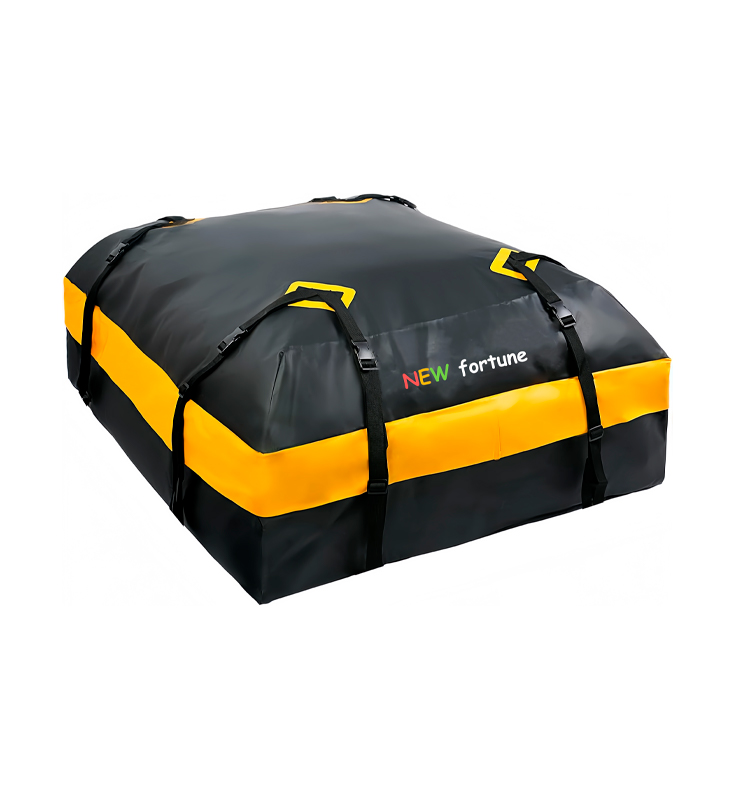 FO-10 15 Cubic Foot 500D Grid PVC Roof BagA mid-volume 15-cubic-foot carrier in 500D grid PVC, with heat-sealed seams and door-hook mounting for SUVs, sedans and vans without permanent racks.View Product →
There are three mounting routes: crossbars on raised rails, a bare roof anchored through the four door openings, and a roof basket. Bare roof mounting requires four door frames and webbing straps of at least 25 mm width.
A car roof bag is a soft-shell, collapsible cargo carrier, usually 11 to 25 cubic feet, mounted either to a roof rack or directly to a bare roof through door-frame anchors.
Whichever route you use, the anti-slip mat is not optional. A rubberised mat beneath the bag stops the load creeping at highway speed and protects the roof paint from grit that would otherwise grind under the base. A large capacity universal roof bag supplied with a mat removes one purchase decision and one compatibility risk.
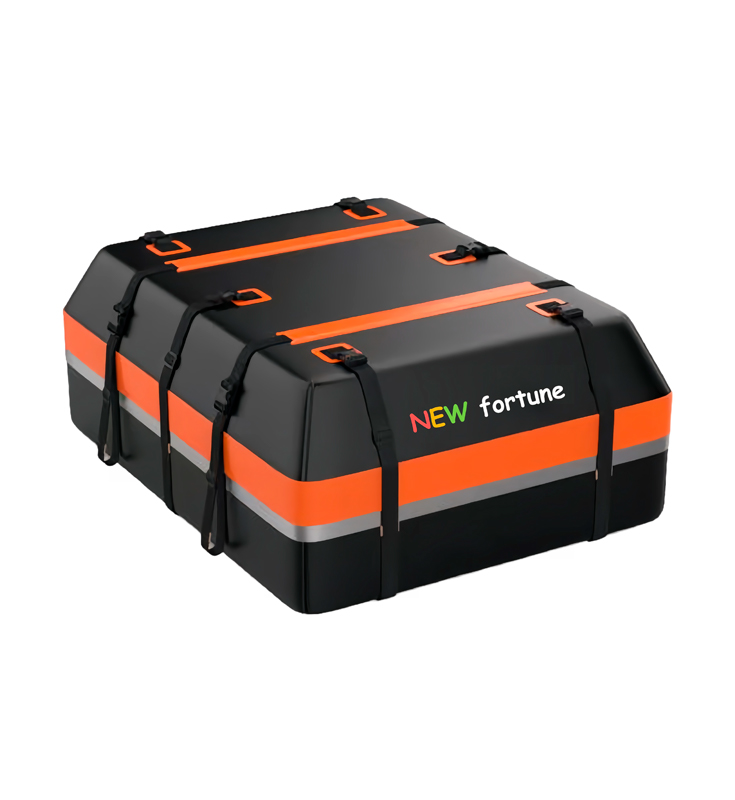 FO-14 21 Cubic Foot Universal Roof Bag with Anti-Slip MatA large 21-cubic-foot roof carrier that includes an anti-slip mat, heat-sealed PVC construction and universal door-hook mounting for road trips and bulky sports gear.View Product →
Put about 60 percent of the load weight in the centre of the bag, between the crossbars, and expect a roof load to add 10 to 25 percent to highway fuel consumption.
Heavy items go low and centred. Aerodynamic drag rises with the square of speed, so the penalty at 75 mph (120 km/h) is roughly double the penalty at 55 mph (88 km/h), and crosswinds make it worse. Reducing cruising speed is the single most effective way to keep both fuel use and strap stress under control.
Never take a loaded roof through an automatic car wash, and remove the bag when it is not in use. An empty bag still adds drag and wind noise, and roof hardware left in place for months will eventually mark the paint.
For volume buyers, four checks separate a manufacturing partner from a trading company: fabric denier and coating verification, weld peel strength, a hydrostatic head test report, and a documented carton drop test.
Construction also drives the commercial terms. A welded carrier bag needs a high-frequency welding line and a sealing die, while a stitched bag needs a sewing line; the two routes carry different minimum order quantities, and mixing them on one purchase order slows sampling and complicates quality control.
A roof bag that fails in service fails in public. At 70 mph a torn strap is a road hazard, not a warranty claim, which is why weld inspection data belongs in the purchase order.
New Fuda Luggages & Bags Co., Ltd., the manufacturer behind this site, has produced outdoor, cycling, fishing and travel bags from Pinghu City, Zhejiang Province since 2006, working in both sewing and high-frequency welding. Its welded series supplies cross-border sellers and importers across Europe, the Americas and Japan.
A bag carries whatever remains under the vehicle's dynamic roof limit after the empty bag and crossbars are subtracted: about 41 kg (90 lb) on a passenger car with a 50 kg limit, 64 kg (141 lb) on a 75 kg crossover and 87 kg (192 lb) on a 100 kg full-size SUV. A 15 cubic foot bag of clothing typically weighs 25 to 30 kg, so textiles rarely approach the limit while water, tools and tinned food reach it immediately.
Yes, when the fabric is coated and the seams are welded or taped. A hydrostatic head of 5,000 mm measured under ISO 811, combined with a covered waterproof zipper and a rolled closure, keeps out sustained highway rain. Stitched seams without taping are the usual source of wet gear. Check strap tension at every stop, because a loose bag flaps and works water into the closure.
Yes, on vehicles with four door openings and reinforced door frames. Door-hook webbing straps pass through the door openings and anchor the bag to the roof panel. Frameless glass, two-door bodies and some sliding doors are not suitable, and those vehicles need crossbars instead.
Volume matters less than frontal area and speed. A roof load adds roughly 10 to 25 percent to highway fuel consumption, and an empty 20 cubic foot bag creates nearly the same drag as a full one, so remove it between trips.
Your email address will not be published. Required fields are marked *
* Your email is safe with us, we don't spam.

Professional R & D and manufacturing of outdoor sports, cycling, fishing, business, travelling sewing, high-frequency stamping series of luggage enterprises
E-mail: christine@fudabags.com
Phone: +86-13819351116
Add: No.2288 Xinggong Road, Pinghu City, Jiaxing City, Zhejiang Province, China
Copyright © 2025 by New Fuda Luggages & Bags Co., Ltd. Rights Reserved. Privacy Custom Durable Outdoor Travel Bag Manufacturers


 English
 Français
 Español